Get your oven to 400 degrees Fahrenheit. This is important: you don't need to grease the cookie sheet. Your scones won't stick, and it actually helps them bake more evenly.
Sift together the flour, baking powder, salt, and sugar in a large bowl. Yes, sift it. This incorporates air into the flour and helps everything combine evenly. It takes about 30 seconds and makes a real difference.
Take your cold butter chunks and use two forks or a pastry blender to cut them into the flour mixture. You're working the butter into the flour until the whole thing looks like coarse crumbs. Some people say bread crumbs, some say sand. Either way, you should see little bits of butter distributed throughout. This step is important because those little butter pockets create the flaky texture. Don't skip it or rush it.
Make a well in the center of your flour mixture. Pour in the cup of heavy cream. Now fold everything together just until it's combined. Don't overmix this. Seriously, just fold it a few times until it all comes together. Overmixing develops gluten, which makes tough scones. You want tender scones, so don't overwork it.
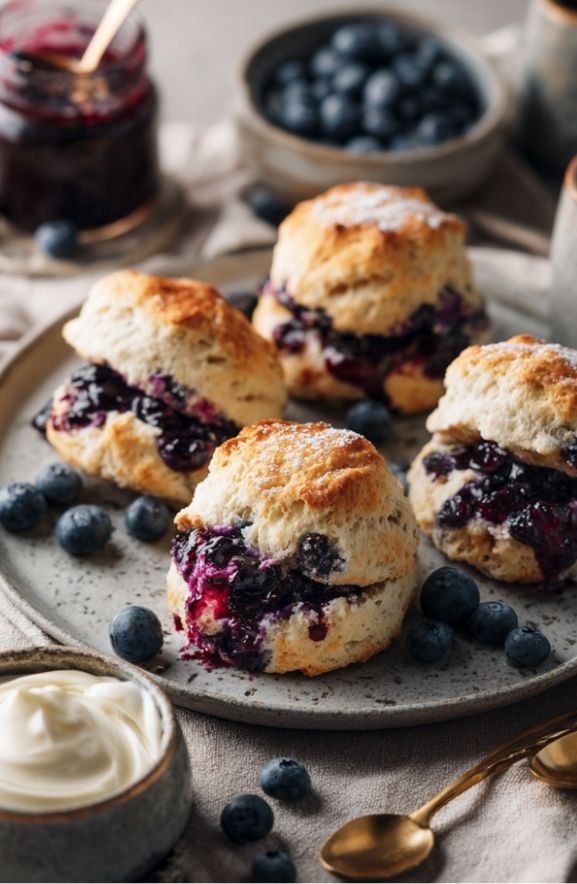
Gently fold the fresh blueberries into the dough. The recipe specifically says to take care not to mash or bruise them because their strong color will bleed into the dough. This is actually important if you want your scones to look pretty and white instead of gray-blue. Be gentle. Think of it like folding in something delicate, because you are.
Turn the dough out onto a lightly floured surface. Press it out into a rectangle about 12 by 3 by 1 1/4 inches thick. Don't worry about perfection here. Approximate is fine.
Cut the rectangle in half. Then cut those halves in half again. You should have four pieces now (3-inch squares). Now cut each square in half on a diagonal. This gives you those classic triangle-shaped scones. You should end up with 8 scones total.
Place your triangles on the ungreased cookie sheet. Brush the tops with a little heavy cream. This creates that beautiful golden-brown crust when they bake.
Bake for 15 to 20 minutes until they're beautiful and brown. Start checking around 15 minutes. Oven temperatures vary, so keep an eye on them. You want them golden brown on top, and a toothpick inserted in the center should come out with just a few moist crumbs.
Let the scones cool a bit before you apply the glaze. You want them cooled enough that the glaze doesn't just slide right off, but still warm enough that it drapes nicely. About 5-10 minutes should do it.
In a microwave-safe bowl, mix the lemon juice and confectioners' sugar together. Stir until the sugar dissolves. There shouldn't be any gritty bits.
Add the lemon zest and the tablespoon of butter to your glaze mixture.
Nuke it for 30 seconds on high. This melts the butter and warms everything up a little. If you want to do the traditional double boiler method, go for it. But honestly, the microwave works great and is way faster.
Whisk the glaze to smooth out any lumps. It should be smooth and glossy.
Drizzle the glaze over the top of your cooled scones. Let it set for about a minute before serving. This gives it a chance to harden slightly and look pretty.