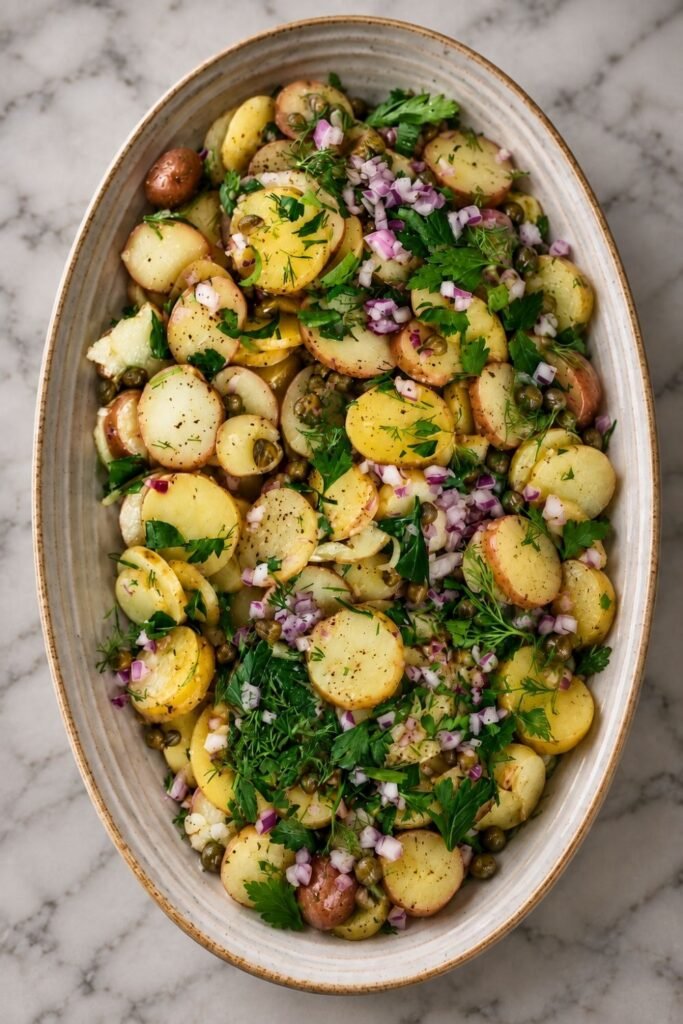


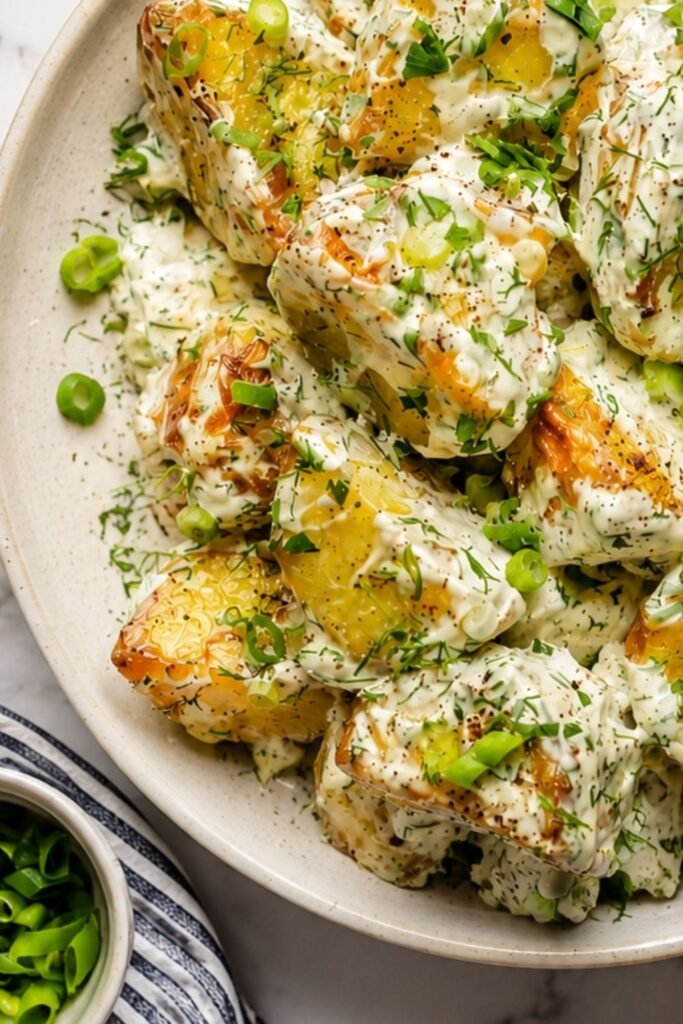
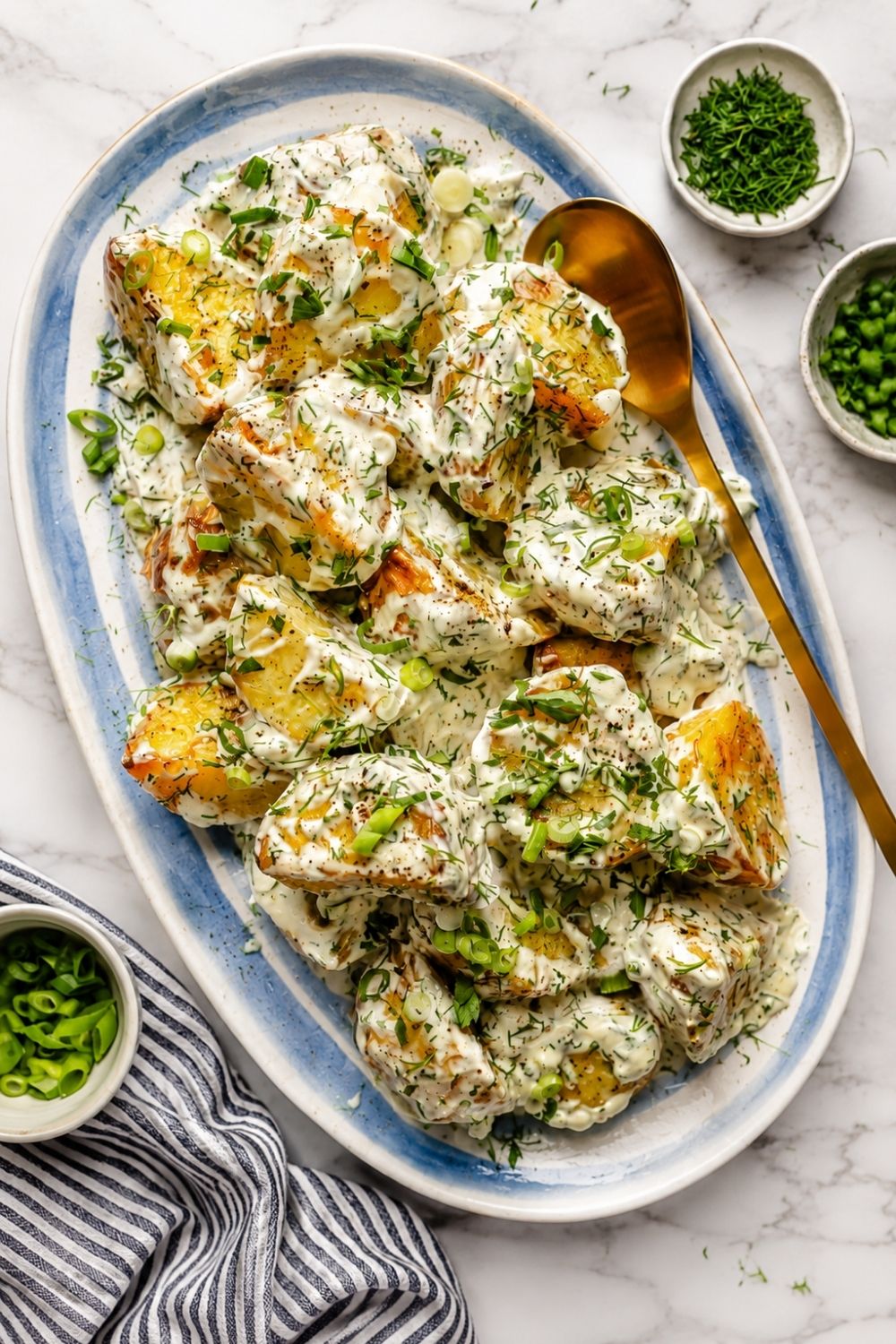
The first thing you notice is the sound. Instead of the soft, uniform bite of a classic bowl of potato salad, these potatoes have brittle roasted edges that give way to a fluffy interior, all of it coated in a cool herb dressing that hasn’t had time to soften them. That contrast is the entire point of this crispy potato salad, and it comes from a two stage approach to the potatoes: they’re boiled until tender, then spread on a sheet pan and roasted at 400°F until they’re genuinely brown and crisp.
The dressing stays deliberately simple so the texture stays the star. Sour cream and mayonnaise build the base, dijon and lemon juice cut the richness, and a generous amount of dill, parsley, and scallions keeps it fresh rather than heavy. It’s served the moment it’s tossed, which is the one piece of timing that separates a crispy potato salad from a very good but ordinary one.
Here’s what you’re getting from this method.
- Boiling then roasting gives you crackly edges and a creamy interior in the same bite
- The dressing needs no cooking and comes together while the potatoes roast
- Dijon and lemon juice keep a sour cream and mayo base from tasting flat or heavy
- Herbs are split between the dressing and the finish, so the top layer tastes fresh rather than muted
- Yukon golds hold their shape through both cooking stages instead of collapsing
Why The Potatoes Get Cooked Twice
Roasting raw potato chunks straight from the board gives you a crisp exterior, but the inside often stays dense and slightly waxy, especially in 2-inch pieces. Boiling first solves that. The interior cooks through fully and turns fluffy, and the starch on the cut surfaces gets softened and roughed up in the process.
That roughened surface is what browns so aggressively in the oven. Once the boiled potatoes hit hot oil and a 400°F sheet pan, all those slightly broken edges dry out and crisp before the middle has any chance to dry out with them. You end up with two distinct textures in one piece.
It also means the 30 minutes in the oven are doing one job only, which is browning. The potatoes are already cooked when they go in, so you’re free to judge them entirely by color and crispness rather than worrying about a raw center.
The Ingredients Doing The Real Work
Most of this list is straightforward, but a few items are carrying more weight than they look. The potato variety, the two dairy elements, and the acid are the ones that decide how this turns out.
- Yukon gold potatoes: Their moderate starch content is the compromise that makes this work. They stay intact through boiling instead of falling apart, but still turn fluffy inside and brown well on the outside.
- Olive oil: Three tablespoons is enough to coat every surface without pooling on the pan. Oil is what conducts heat into the potato skin and edges, so an even coating is what gives you even browning.
- Mayonnaise: The oil in mayonnaise gives the dressing body and helps it cling to irregular roasted surfaces rather than sliding off into the bottom of the bowl.
- Sour cream: Thinner and tangier than mayonnaise, it loosens the dressing to a spoonable consistency and adds the lactic sharpness that keeps the whole bowl from tasting like straight mayo.
- Dijon mustard: Beyond flavor, mustard helps hold an oil and dairy mixture together so the dressing stays smooth instead of separating as it sits.
- Lemon juice: The acid is what makes a rich dressing taste light. Without it, the sour cream and mayo read as heavy against starchy potatoes.
- Fresh dill and parsley: Dill brings the grassy, slightly anise note that reads as classic potato salad, while parsley keeps it clean and stops the dill from dominating.
- Scallions: Raw onion flavor without the aggression of a raw white or red onion, plus a little crunch in the finish.
Notice that the scallions, dill, and parsley are all divided. Some goes into the dressing, where the flavor melts into the sour cream base, and some is scattered over the top at the end, where it stays sharp and distinct. That split is why the finished bowl tastes fresh instead of uniformly herby.
Roasting The Potatoes Until They Actually Crisp
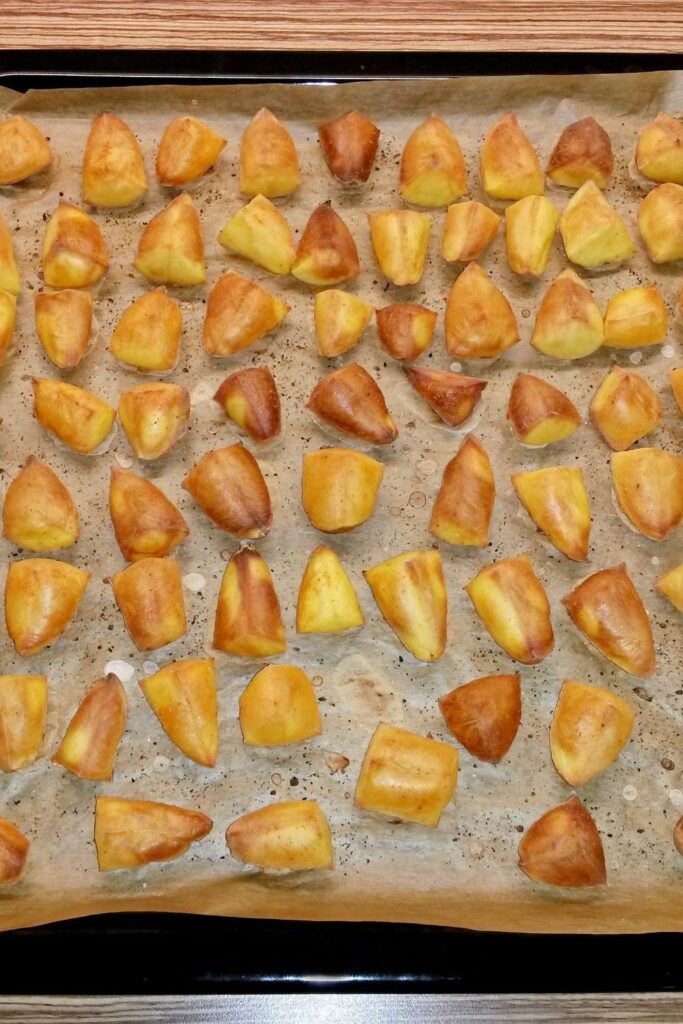
This is the step that decides whether you’ve made a crispy potato salad or a warm potato salad. After boiling, the potatoes get tossed with olive oil, garlic powder, salt, and pepper, then spread on a foil lined sheet pan and roasted at 400°F for about 30 minutes.
Two things matter here. The first is the even layer. Potatoes that are piled up will steam each other, and steam is the enemy of a crisp surface. Give every piece contact with the pan and a little space around it. If your sheet pan is crowded, the pieces sitting on top will come out pale and soft while the ones underneath brown.
The second is patience with color. The instruction is to bake until the potatoes are very brown and crispy, and “very brown” is a stronger cue than most people expect. A light golden tint is not done. You’re looking for deep brown, almost mahogany edges that feel firm and slightly rough when you nudge one with a spatula. A potato that still looks tan will soften the instant dressing touches it.
Handle them gently when you toss them in oil. They’ve already been boiled and are fragile at the edges, and those slightly ragged surfaces are exactly what you want to keep intact, since they’re the parts that crisp hardest.
Building A Dressing That Coats Instead Of Slides
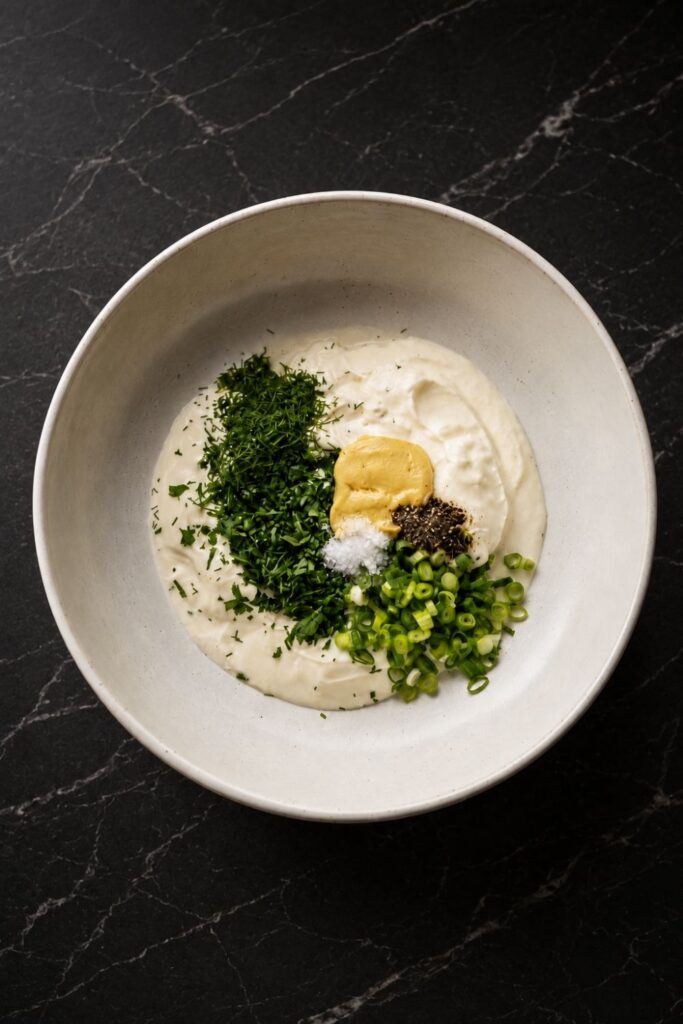
The dressing comes together entirely in one bowl while the potatoes are in the oven, which is the most efficient window in the whole recipe. Sour cream and mayonnaise go in first and get combined into a smooth base, then the remaining scallions, 1 tablespoon of dill, 1 tablespoon of parsley, dijon mustard, and lemon juice are stirred in.
Add the lemon juice and mustard after the dairy base is smooth rather than at the same time. Mixing thick ingredients together first gives you a uniform texture, and the thinner acidic elements then loosen it evenly instead of creating watery streaks that you have to chase with a spoon.
Season with salt and pepper at the end, after the herbs and acid are in. Lemon juice and dijon both amplify perceived saltiness, so seasoning early usually means overshooting. Taste, then adjust.
The finished dressing should be thick enough to hold its shape on a spoon for a moment before slowly settling. That consistency is what lets it grab onto craggy roasted potatoes rather than running straight to the bottom of the serving dish.
The Mistake That Undoes All The Roasting
If this recipe fails, it fails in the last two minutes, not in the oven.
Dressing the potatoes early is the single most reliable way to lose the crispness you just spent 45 minutes building. A crisp roasted surface is essentially a dry, brittle crust, and moisture is what destroys it. Sour cream and mayonnaise are largely water and oil, and once they’re in contact with hot potato, that moisture soaks straight into the crust and softens it. Ten minutes is enough to turn crackly edges into something closer to a standard creamy potato salad.
Plan around this. Have the serving dish out, the reserved herbs chopped, and the table ready before you combine anything. Toss, transfer, top with the reserved scallions, dill, and parsley, and take it straight out.
How It Comes Together
The process runs in two parallel tracks that meet at the very end. The potatoes go through their long path first: cold water and salt, a boil, 12 to 16 minutes of simmering, a drain, an oil and seasoning toss, then 30 minutes in a 400°F oven.
While the sheet pan is working, you’re free. That’s when the dressing gets made and the reserved tablespoon of scallions and the remaining dill and parsley get set aside for the finish. By the time the potatoes come out deeply browned, the only remaining decisions are when you want to eat and how much salt the dressing needs.
The last stage is fast and deliberate. Combine, transfer, garnish, serve.
Ingredients
Everything below is grouped by where it goes. The potatoes and their seasoning are one unit, and the dressing is another, and the two don’t meet until the final step. Yield is 6 servings at 329 kcal each.
- 3 lbs Yukon gold potatoes, cut into 2-inch pieces keep the pieces roughly even so they finish boiling at the same time
- 3 tablespoons olive oil
- 1/2 teaspoon garlic powder
- Kosher salt and freshly cracked black pepper, to taste
- 1/2 cup sour cream
- 1/2 cup mayonnaise
- 1/4 cup finely chopped fresh scallions, divided 1 tablespoon is held back for the finish
- 2 tablespoons finely chopped fresh dill, divided 1 tablespoon goes into the dressing
- 2 tablespoons finely chopped fresh parsley, divided 1 tablespoon goes into the dressing
- 1 tablespoon Dijon mustard
- 1 tablespoon lemon juice
- Kosher salt and freshly cracked black pepper, to taste
Note that a separate 1 tablespoon of salt is used to season the boiling water, listed within the first step below.
Instructions
Read through step six before you start, since the timing of that step is what protects the texture.
- Boil the potatoes. Put the cubed potatoes into a large stock pot filled with cold water, add 1 tablespoon salt, and bring it to a boil over high heat. Once it’s boiling, drop the heat to medium-high and cook the potatoes until tender, about 12 to 16 minutes. They’re ready when a fork slides into a piece without resistance. Drain them.
- Heat the oven and season the potatoes. Preheat the oven to 400°F and line a baking sheet with aluminum foil, then set it aside. In a bowl, combine the drained potatoes with the olive oil, garlic powder, salt, and pepper, tossing gently so the edges stay intact and every piece gets an even coating.
- Roast until deeply browned. Spread the potatoes across the prepared baking sheet in a single even layer, giving them room rather than piling them up. Bake for about 30 minutes, until they’re very brown and crispy on the outside.
- Start the dressing base. While the potatoes roast, combine the sour cream and mayonnaise in a large bowl and stir until the mixture is smooth and one uniform color.
- Finish the dressing. Reserve 1 tablespoon of the scallions for later, then add the remaining scallions to the bowl along with 1 tablespoon of the dill, 1 tablespoon of the parsley, the dijon mustard, and the lemon juice. Stir to combine, then season with salt and pepper to taste. Taste after the acid is in, since lemon and mustard both sharpen how salty it reads.
- Dress at the last moment. Wait until right before serving to toss the potatoes in the dressing. Dressing them any earlier lets moisture soak into the crisp surfaces and softens them.
- Garnish and serve. Transfer everything to a serving dish and top with the reserved scallions along with the remaining dill and parsley.
Crispy Potato Salad
Ingredients
Method
- Boil the potatoes. Put the cubed potatoes into a large stock pot filled with cold water, add 1 tablespoon salt, and bring it to a boil over high heat. Once it’s boiling, drop the heat to medium-high and cook the potatoes until tender, about 12 to 16 minutes. They’re ready when a fork slides into a piece without resistance. Drain them.
- Heat the oven and season the potatoes. Preheat the oven to 400°F and line a baking sheet with aluminum foil, then set it aside. In a bowl, combine the drained potatoes with the olive oil, garlic powder, salt, and pepper, tossing gently so the edges stay intact and every piece gets an even coating.
- Roast until deeply browned. Spread the potatoes across the prepared baking sheet in a single even layer, giving them room rather than piling them up. Bake for about 30 minutes, until they’re very brown and crispy on the outside.
- Start the dressing base. While the potatoes roast, combine the sour cream and mayonnaise in a large bowl and stir until the mixture is smooth and one uniform color.
- Finish the dressing. Reserve 1 tablespoon of the scallions for later, then add the remaining scallions to the bowl along with 1 tablespoon of the dill, 1 tablespoon of the parsley, the dijon mustard, and the lemon juice. Stir to combine, then season with salt and pepper to taste. Taste after the acid is in, since lemon and mustard both sharpen how salty it reads.
- Dress at the last moment. Wait until right before serving to toss the potatoes in the dressing. Dressing them any earlier lets moisture soak into the crisp surfaces and softens them.
- Garnish and serve. Transfer everything to a serving dish and top with the reserved scallions along with the remaining dill and parsley.
Notes
Recipe Notes
A few practical points that make the timing easier to manage.
The dressing can be mixed while the potatoes are in the oven, which is how the recipe is written, and it holds fine in the bowl until the potatoes are ready. The potatoes are the component that can’t wait, not the dressing.
Cut the potatoes as evenly as you can at 2 inches. Uneven pieces boil unevenly, and a small piece that’s overcooked at the boiling stage will break apart when you toss it in oil.
If your baking sheet can’t hold 3 lbs of potatoes in a genuine single layer, use two pans rather than crowding one. Crowded potatoes steam instead of crisping, and you’ll lose the texture the recipe is built around.
Because this dish depends on contrast between hot crisp potatoes and a cool dressing, it’s at its best immediately after tossing rather than after sitting.
Common Questions
Can I use a different potato variety?
Yukon golds are specified because they hold together through boiling and still brown well. Waxier potatoes like red or new potatoes will stay intact but tend to crisp less dramatically, while starchy russets crisp beautifully but are more likely to break apart during the boil and the toss. Either can work, but expect a different texture from the one described here.
Why boil the potatoes at all if they’re going in the oven?
Boiling cooks the interior through and softens the cut surfaces, which is what allows them to brown so heavily during the 30 minutes of roasting. Roasting alone would leave you with a firmer, denser interior and less contrast against the crisp exterior.
Can I make the dressing ahead of time?
Yes, the dressing itself is a simple no-cook mixture that you can stir together in advance. What shouldn’t be done ahead is combining it with the potatoes, since that’s what softens the crisp edges.
Can I use dried herbs instead of fresh?
The recipe calls for fresh dill, parsley, and scallions, and the finishing garnish in particular relies on fresh herbs for its bright flavor and texture. Dried herbs would change the character of the dish noticeably, especially in the topping, so it’s worth using fresh if you can.
How do I know the potatoes are crisp enough before dressing them?
Go by color and feel rather than the clock alone. Deeply browned edges that look almost mahogany and feel firm and rough when nudged are the signal. Pale golden potatoes haven’t developed enough of a crust to survive contact with the dressing.
Conclusion
Serve this the moment the potatoes hit the dressing and you get something no standard potato salad delivers: shattering browned edges, a fluffy interior, and a cool, tangy herb coating that hasn’t had a chance to soften any of it.