

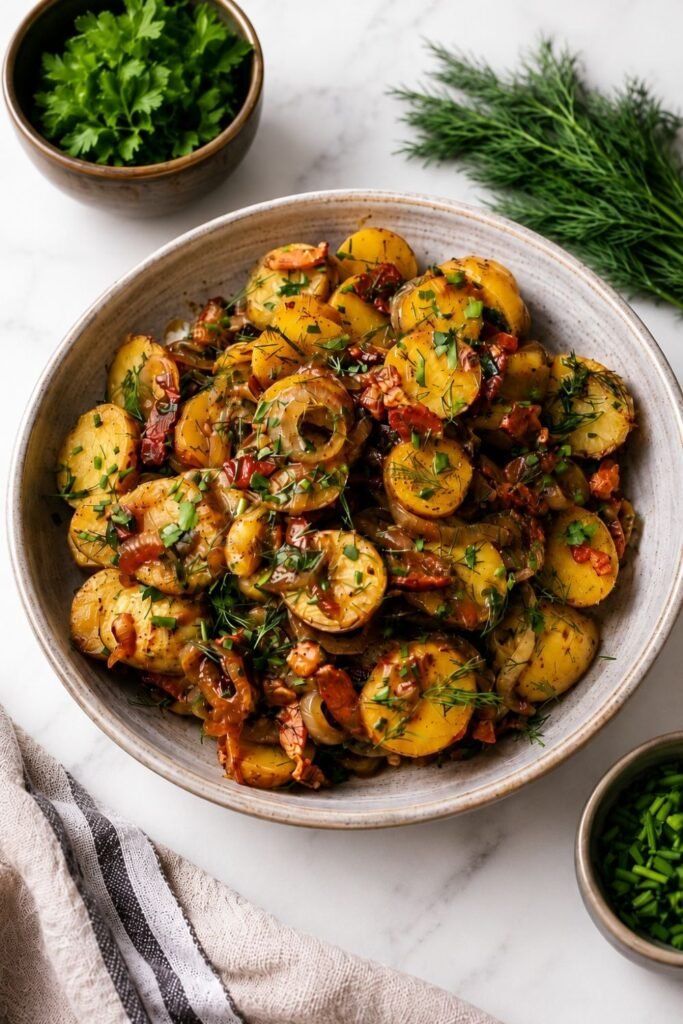
There’s no mayonnaise here, and that single absence changes everything. Instead of a cold, creamy bowl, German potato salad leans on a warm dressing built directly in the bacon pan: rendered fat, softened onion, red wine vinegar, beef broth, and just a tablespoon of sugar to round off the sharpness. The potatoes go in warm and drink it up.
That last part is the mechanism the whole dish depends on. Warm potato slices absorb liquid in a way cold ones simply won’t, so the vinegar and broth soak into the interior rather than sitting on the surface. The result tastes seasoned all the way through, tangy and savory at once, with crisp bacon and fresh herbs folded through in two stages.
It’s a substantial bowl at 5 pounds of potatoes and a full pound of bacon, and it’s meant to be eaten warm, after a short rest that lets the flavors settle.
A few things this method gets right.
- The dressing is made in the bacon pan, so none of the rendered flavor gets thrown away
- Potatoes are sliced while still warm, which is when they absorb the most dressing
- Red wine vinegar and beef broth give a tangy, savory base with no mayonnaise to weigh it down
- Bacon and herbs are split, so half melts into the salad and half stays crisp and bright on top
- The 15 to 20 minute rest lets the potatoes finish soaking up the dressing before you serve
Warm Potatoes Are The Whole Trick
Cook the potatoes, cool them just enough to handle, and slice them while they’re still warm. That instruction sounds like a convenience note. It isn’t.
A warm potato is porous and slightly relaxed. Its starch has gelatinized during boiling and hasn’t yet firmed back up, so when it meets a hot, thin dressing, the liquid moves into the slice instead of pooling around it. A cold potato has retrograded starch, meaning the structure has tightened again, and vinegar dressing mostly beads on the outside.
This is why the recipe warns you not to let them get cold. There’s a window between “too hot to peel” and “cold from sitting,” and that window is where you want to be working. Peel and slice as soon as your hands can stand it.
It’s also why slice thickness matters. At ¼ to ½ inch, you get enough surface area for the dressing to penetrate and enough thickness that the slices survive being tossed in a hot pan without breaking down into mash.
The Ingredients That Decide The Flavor
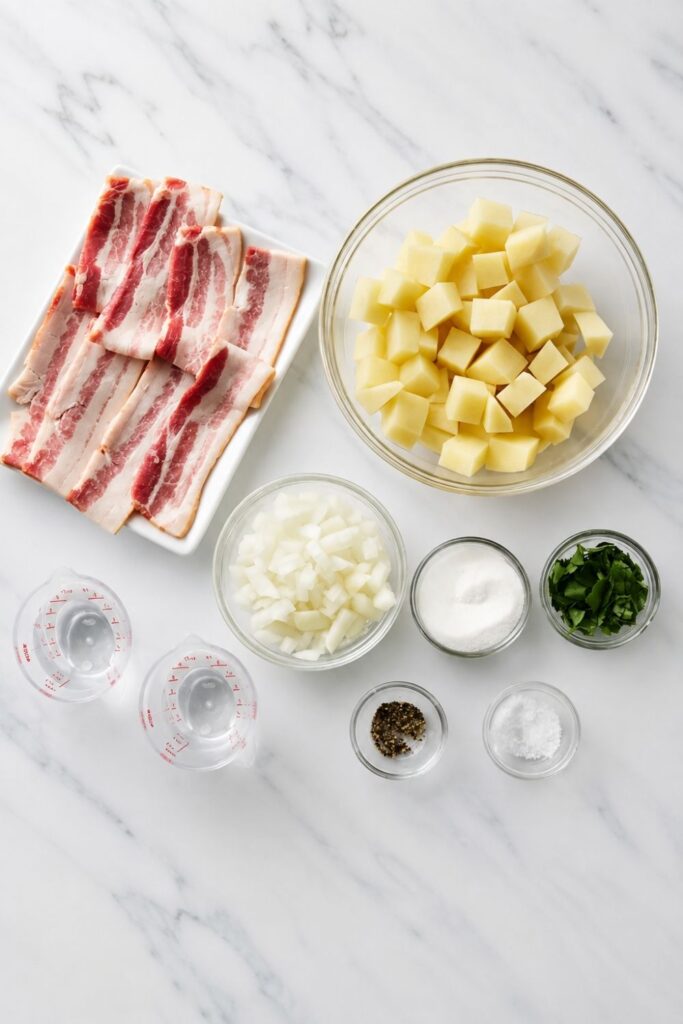
Nine ingredients, and most of them are doing something specific to the balance of the dish. The potato variety, the vinegar, and the broth are the three that would change the outcome most if you swapped them.
- Waxy potatoes: Yellow or red varieties hold their slices together through boiling and then a second stint in the pan. Their lower starch content means they stay in defined pieces rather than crumbling into the dressing.
- Thick-cut bacon: Two jobs. The rendered fat becomes the foundation of the dressing, and the crumbled meat provides the salt and smoke. Thick-cut renders more slowly and gives you meatier pieces that stay chewy rather than shattering.
- Red wine vinegar: The defining flavor. A half cup is a lot of acid, and it’s what makes this taste distinctly German rather than like a creamy deli salad.
- Beef broth: Balances the vinegar with savory depth and dilutes it enough to be pleasant. Without it, the acid would be punishing at that volume.
- Sugar: Only a tablespoon, and it’s not there to sweeten. It softens the edge of the vinegar so the dressing reads as tangy rather than sour.
- White onion: Sliced and softened in the fat and oil, it loses its raw bite and turns mellow and slightly sweet, threading through the potato slices.
- Vegetable oil: Added alongside the bacon grease to make sure there’s enough fat to soften the onions and enough volume in the pan for the dressing.
- Fresh parsley and dill: Green, clean flavor against a rich, acidic, bacon-heavy base. Dill leans traditional, parsley keeps it neutral, and either or both work.
The sugar and the broth are worth reading together. Half a cup of red wine vinegar on its own would be sharp enough to make you wince. Paired with half a cup of broth and a tablespoon of sugar, it lands as brightly tangy instead.
Building The Dressing In The Bacon Pan
After the bacon comes out, the grease stays in. That’s not a shortcut, it’s the point. Everything that rendered out of a pound of thick-cut bacon is now the flavor base for the dressing.
Add the vegetable oil and the sliced onion to that pan and cook over medium heat for about 5 minutes, until the onion has softened. You’re looking for slices that have gone limp and translucent, losing their opacity and their raw sharpness. Don’t rush this into browning, since deeply caramelized onion would push the flavor in a different direction than the tangy, savory profile this dish wants.
Then the vinegar, beef broth, and sugar go in together, and the mixture comes up to a light boil. A light boil means small bubbles breaking gently across the surface, not a hard rolling boil. This does two things: it dissolves the sugar completely and it lets the harshest volatile edge of the vinegar cook off, leaving the tang behind without the raw sting.
Any browned bacon residue stuck to the pan bottom will loosen as the liquid heats. Scrape it up as you stir, because that’s concentrated flavor going straight into the dressing.
How To Keep The Slices Intact
The most likely way this goes wrong is texture. You end up with a bowl of broken, mushy potato instead of distinct slices, and it happens at one of two points.
The first is the boil. The instruction is to test with a fork and drain when the potatoes reach the consistency you want, around 20 minutes. Whole potatoes cook unevenly if they vary a lot in size, so start checking the smaller ones early. A fork should meet slight resistance at the center rather than sliding through with no effort at all. Potatoes cooked to complete softness will fall apart the moment you slice them.
The second is the toss. Once the potatoes go into the pan with the bacon and herbs, the recipe says to toss gently and stir occasionally while they warm through. Stirring hard, or stirring constantly, breaks down slice edges and clouds the dressing with starch.
Why The Bacon And Herbs Are Split
Half the bacon and half the herbs go into the pan, and half go on top at the end. That division is deliberate.
The portion that goes in during cooking softens. Bacon in a hot vinegar dressing loses its crispness within minutes, and the herbs wilt and give up their flavor into the liquid. That’s exactly what you want from that half, since it seasons the whole bowl from the inside.
The portion added at the end keeps its character. Crisp bacon on top gives you texture contrast against soft potato slices, and fresh, unwilted herbs deliver a green aroma that’s already gone from the cooked half. Add the second half after the salad comes off the heat, not before.
The Rest Before Serving
After topping with the remaining bacon and herbs, the salad sits for 15 to 20 minutes before you serve it.
This is when the dressing finishes its work. The potatoes are still warm and still absorbing, and that time lets the vinegar and broth move deeper into each slice instead of sitting mostly on the surface. Skip the rest and the salad tastes like potatoes with dressing on them. Give it the time and it tastes like one thing.
It also brings the temperature down from hot to warm, which is how this is meant to be eaten. Warm, not scalding and not chilled.
Ingredients
The list splits cleanly into the potatoes and everything that becomes the warm dressing. Pay particular attention to the potato variety and the vinegar, since those two set the character of the dish.
- 5 pounds waxy potatoes, yellow or red pick similar sizes so they finish boiling together
- 1 pound thick-cut bacon the rendered grease stays in the pan and becomes part of the dressing
- 1/4 cup vegetable oil
- 1 small white onion, sliced
- 1/2 cup red wine vinegar
- 1/2 cup beef broth
- 1 tablespoon sugar
- Kosher salt and black pepper, to taste
- ¼ cup chopped fresh parsley and/or fresh dill half goes into the pan, half goes on top
Instructions
Read through the first two steps before you begin, since the bacon and the potatoes ideally cook at the same time.
- Boil and slice the potatoes. Boil the potatoes, testing them by piercing with a fork, and drain them once they reach the consistency you want, which takes about 20 minutes. Let them cool only until you can handle them without burning yourself, and don’t let them go cold. Peel them and cut into slices ¼ to ½ inch thick, then put them in a large bowl.
- Render the bacon. Cook the bacon in a large pan over medium heat until crispy. Move it to a paper towel lined plate and crumble it, but leave all the grease behind in the pan.
- Soften the onion. Add the vegetable oil and the sliced onion to that same pan and cook until softened, about 5 minutes. The slices should turn limp and translucent rather than browning.
- Build the dressing. Mix in the red wine vinegar, beef broth, and sugar, and bring it to a light boil. Scrape up anything stuck to the bottom of the pan as the liquid heats.
- Fold in the potatoes. Gently toss in the sliced potatoes, half of the bacon, and half of the herbs. Cook until warmed through, stirring occasionally and lifting from underneath rather than dragging a spoon through, so the slices stay whole. Season with kosher salt and black pepper to taste.
- Top and rest. Scatter the remaining bacon and herbs over the top. Let it sit for 15 to 20 minutes so the flavors can absorb, then serve warm.
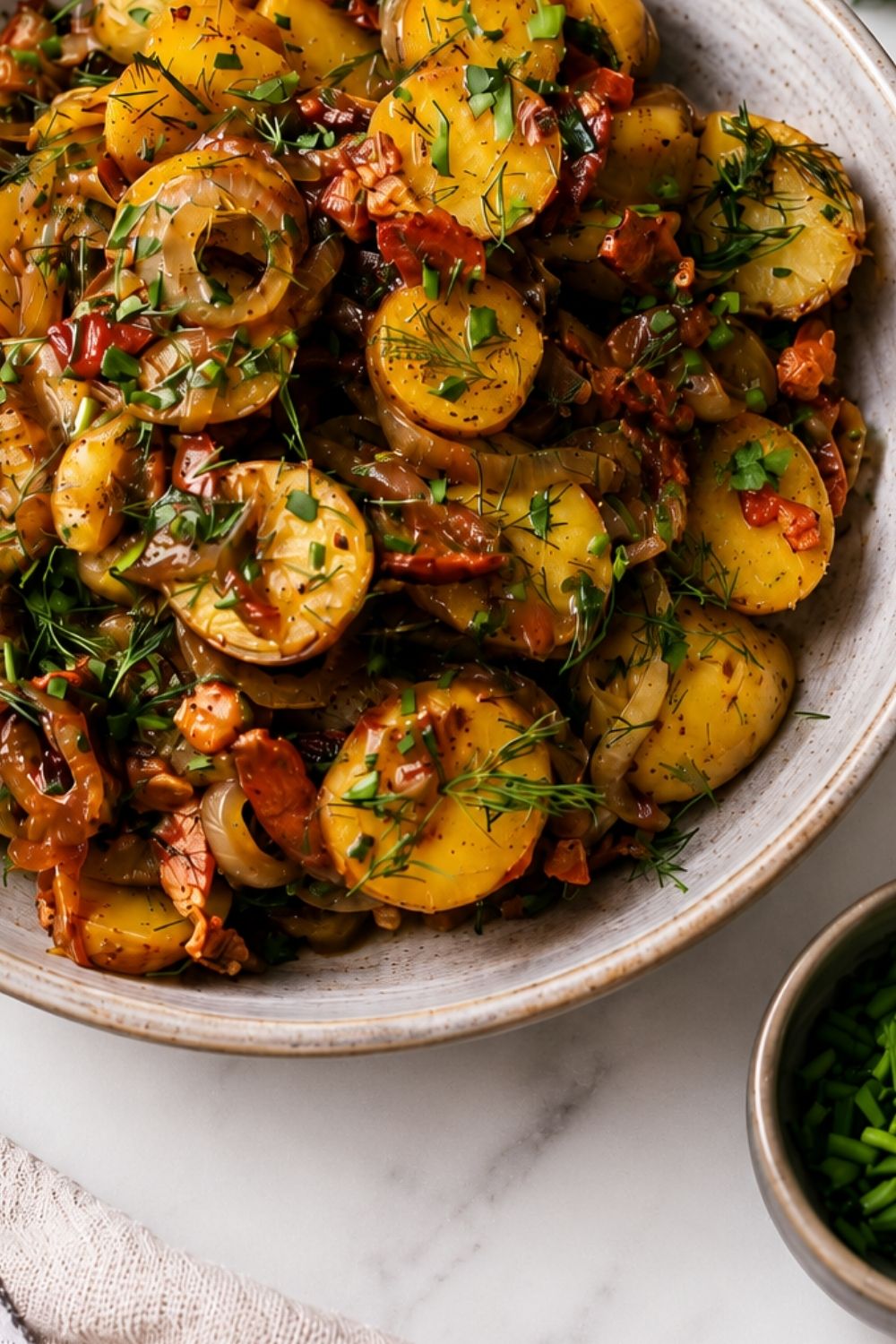
German Potato Salad With Bacon And Warm Vinegar Dressing
Ingredients
Method
- Boil and slice the potatoes. Boil the potatoes, testing them by piercing with a fork, and drain them once they reach the consistency you want, which takes about 20 minutes. Let them cool only until you can handle them without burning yourself, and don’t let them go cold. Peel them and cut into slices ¼ to ½ inch thick, then put them in a large bowl.
- Render the bacon. Cook the bacon in a large pan over medium heat until crispy. Move it to a paper towel lined plate and crumble it, but leave all the grease behind in the pan.
- Soften the onion. Add the vegetable oil and the sliced onion to that same pan and cook until softened, about 5 minutes. The slices should turn limp and translucent rather than browning.
- Build the dressing. Mix in the red wine vinegar, beef broth, and sugar, and bring it to a light boil. Scrape up anything stuck to the bottom of the pan as the liquid heats.
- Fold in the potatoes. Gently toss in the sliced potatoes, half of the bacon, and half of the herbs. Cook until warmed through, stirring occasionally and lifting from underneath rather than dragging a spoon through, so the slices stay whole. Season with kosher salt and black pepper to taste.
- Top and rest. Scatter the remaining bacon and herbs over the top. Let it sit for 15 to 20 minutes so the flavors can absorb, then serve warm.
Notes
Recipe Notes
A handful of practical points on timing and handling.
Peeling is easier while the potatoes are warm than after they’ve cooled, and the skins on boiled waxy potatoes often slip off with light pressure from your thumb or the back of a knife.
Choose potatoes of a similar size for the pot. Five pounds of mixed small and large potatoes will finish at different times, and the smaller ones will be overcooked by the time the larger ones are ready.
You’ll need a large pan for the final stage, since 5 pounds of sliced potatoes takes up real space. If your pan is crowded, folding gently becomes difficult and the slices are more likely to break.
The recipe is written to be served warm after its rest. It’s not designed as a chilled make-ahead salad, since the texture and the way the dressing sits both change once the potatoes cool.
Questions Worth Answering
Can I use russet potatoes?
The recipe specifies waxy potatoes, yellow or red, for a reason. Russets are high in starch and tend to break apart when boiled, sliced, and then tossed in a pan. You’d likely end up with something closer to a rough mash than defined slices.
Why is there no mayonnaise?
This is the vinegar-based style rather than the creamy American one. The dressing is built from bacon fat, oil, red wine vinegar, and beef broth, which is what gives it the tangy, savory profile and lets it be served warm without anything splitting or curdling.
Can I substitute a different vinegar?
Red wine vinegar is what’s called for, and it brings a specific fruity sharpness at that half-cup volume. Other vinegars would change the flavor balance noticeably, so if you switch, treat it as a variation rather than a straight swap.
Do I have to peel the potatoes?
The recipe peels them after boiling, which gives you clean slices that absorb the dressing evenly across all surfaces. Skins would change the texture and appearance of the finished salad.
Why let it sit for 15 to 20 minutes?
The potatoes keep absorbing dressing during that time while they’re still warm. It’s the difference between potatoes coated in a tangy dressing and potatoes that taste seasoned through to the center.
Conclusion
Served warm, with the vinegar and broth soaked deep into every slice and crisp bacon scattered across the top, this is a potato salad that tastes savory and bright rather than rich and heavy.