

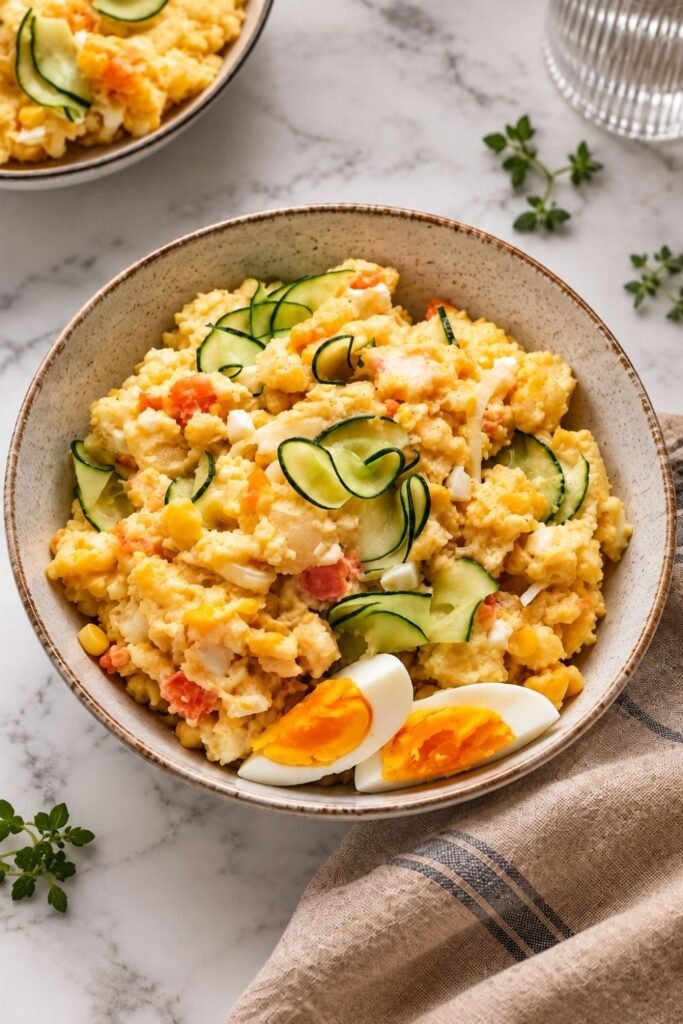
The texture is the first thing that tells you this isn’t a Western potato salad. Instead of firm cubes coated in dressing, you get a soft, half-mashed base with pockets of potato still holding their shape, and everything else folded through it.
That base isn’t bland filler either. Dashi powder and rice vinegar go in while the potatoes are hot enough to absorb them, which seasons the potato itself rather than just the mayonnaise sitting on top. By the time the chopped egg, corn, onion, carrot and ham arrive, the salad already tastes savoury and lightly tangy on its own.
The mayonnaise then does one job well, binding everything into something creamy without turning greasy. It’s a side dish that eats like comfort food, and the whole thing comes together in a single bowl.
Here’s what makes Japanese Potato Salad worth the extra step of chilling.
- Dashi and rice vinegar season the potato from the inside, not just the surface
- Mashing until mostly smooth gives you a creamy base with texture still left in it
- Chilling before the mayonnaise goes in keeps the salad thick instead of oily
- Sweet corn, crisp carrot and raw onion break up the softness in every spoonful
- Boiled eggs and ham turn a side dish into something substantial
- Ten minutes of boiling and one bowl to wash
More Fresh Salad Recipes You’ll Love
What Makes Japanese Potato Salad Different
Most potato salads keep the potato in recognisable pieces and rely on the dressing to carry the flavour. This one inverts that. The potato is mashed until it’s mostly smooth, so it becomes the body of the dish rather than an ingredient suspended in something else.
That changes what the seasoning has to do. A cube of potato only ever tastes seasoned on its outside, but mashed potato takes flavour all the way through. Dashi powder and rice vinegar go straight into the hot mash, where they disperse evenly instead of sitting in a coating.
The result is a salad that has real depth before you’ve added a single spoon of mayonnaise. The dashi contributes savoury umami that reads as broth-like rather than salty, and the rice vinegar adds a soft acidity that’s noticeably gentler than the sharp bite of white vinegar or lemon.
There’s a second effect worth knowing about. Acid keeps mashed potato from tasting heavy and flat, which matters when a third of a cup of mayonnaise is going in later. Without the vinegar, the finished salad would taste rich and one-note. With it, the richness has something to push against.
The Ingredients Doing the Real Work
A short ingredient list means each item has to earn its place. Two of them are doing more than they look like they are: the dashi powder, which replaces a whole spice cabinet, and the rice vinegar, which controls how the mayonnaise behaves later.
- Yukon Gold potatoes: Their medium starch content is the reason this works. They break down enough to mash creamy but hold enough structure that you can leave lumps in without them dissolving.
- Dashi or stock powder: The savoury backbone of the whole dish. It brings umami and salt in one ingredient, which is why the salad tastes seasoned rather than just creamy.
- Rice vinegar: Mild and slightly sweet compared to other vinegars, so it lifts the potato without dominating it. It also cuts the mayonnaise, keeping the finished texture light.
- Mayonnaise: Binds the mash and the mix-ins into one creamy mass. Because the potato is already seasoned, the mayonnaise contributes texture and richness rather than carrying the flavour alone.
- Boiled eggs: Chopped through the mash, they add soft protein and a little extra richness from the yolks, which blend into the base as you mix.
- Corn: Small bursts of sweetness that contrast the savoury dashi, and one of the few things in the bowl that pops when you bite it.
- Onion, sliced: Goes in raw, so it stays sharp and slightly pungent against all that soft potato. Slice it thinly and you get the bite without a mouthful of onion.
- Carrot: The firmest thing in the salad, and the main source of crunch and colour.
- Ham: Optional, but it adds salt and a chewy texture that makes the salad feel more like a meal than a side.
Season the Mash While It’s Still Hot
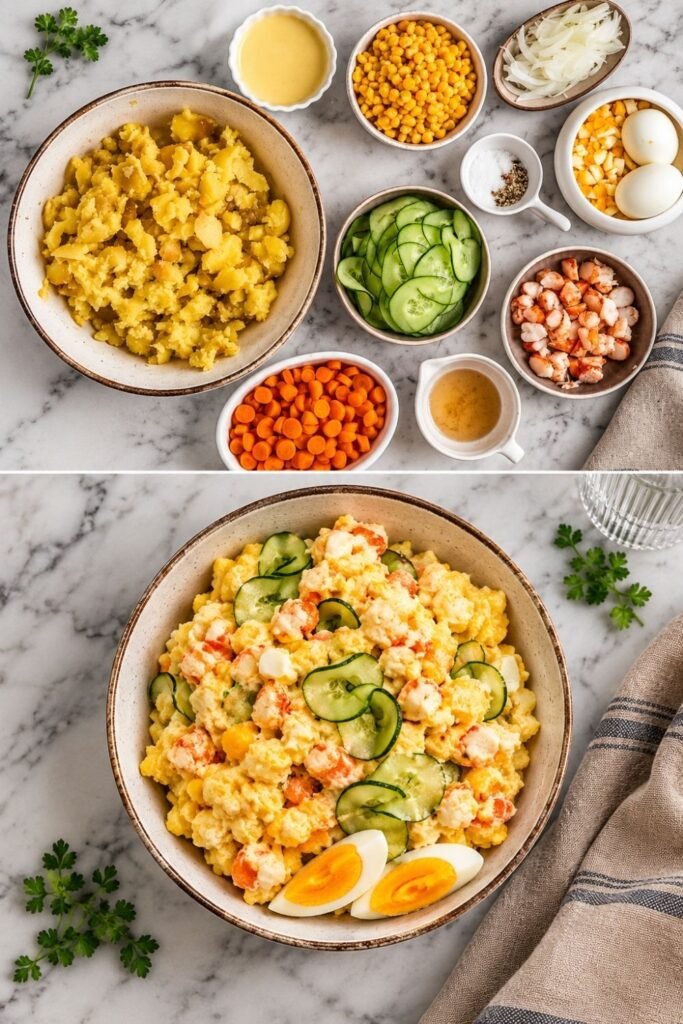
This is the step that decides whether the salad tastes like Japanese potato salad or just mashed potato with mayonnaise in it.
Hot potato is porous and thirsty. Straight out of the pot, the starch granules have swollen and opened up, and anything you stir in gets pulled into the flesh rather than sitting on it. Both the dashi powder and the rice vinegar depend on that. The powder needs residual heat and moisture to dissolve properly, and undissolved dashi means occasional salty specks instead of an even savoury background.
So the order matters. Drain, mash, then stir in the dashi and vinegar immediately, before you do anything else. You’ll notice the mash absorbs the vinegar almost instantly and the smell shifts from plain boiled potato to something warmer and more savoury.
Wait until the potatoes have cooled and neither ingredient goes anywhere useful. The vinegar sits in the bottom of the bowl, the powder stays grainy, and you end up compensating with extra mayonnaise to make it taste like anything.
How Much to Mash
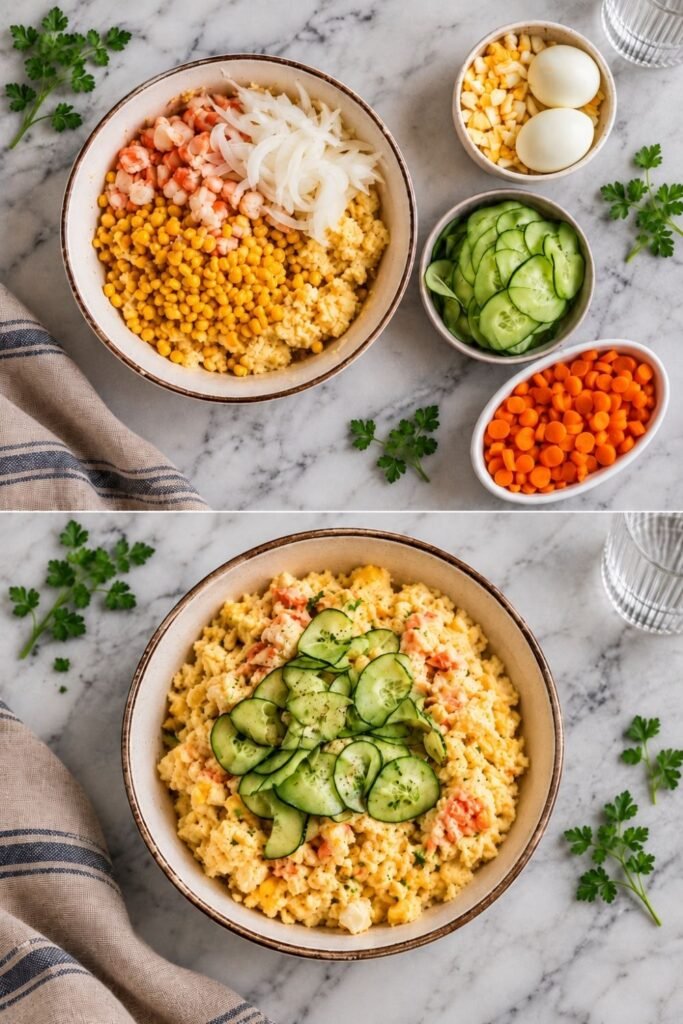
The instruction is to mash until mostly smooth, and that word “mostly” is doing a lot of work.
Fully smooth is a mistake here. Mashed potato worked too hard turns gluey, because ruptured starch granules release long chains that make the texture stretchy and paste-like. Once that happens there’s no fixing it, and adding mayonnaise on top only makes it heavier.
Undermashed is a different problem. Leave the potato in large chunks and the dashi and vinegar have less surface area to soak into, so the seasoning stays patchy and the salad never binds together properly.
Aim for a base that’s creamy across most of the bowl with visible pieces still holding their shape in places. Use a potato masher rather than a food processor or a stick blender, and stop pressing the moment the mash looks broadly uniform. A few lumps are the point, not a failure.
Why the Potatoes Have to Chill First
Refrigerating the seasoned mash before the mayonnaise goes in looks like an optional patience step. It isn’t.
Mayonnaise is an emulsion, oil held in suspension by egg yolk. Heat destabilises that suspension. Stir mayonnaise into warm potato and it thins out and starts to break, releasing oil that pools around the mash and gives the whole salad a greasy, slick mouthfeel. The salad also looks wetter than it should, because what’s spread through it is loose oil rather than creamy dressing.
Cold potato does the opposite. The mayonnaise stays thick and intact, coats everything evenly, and holds the mix-ins in place. That’s what gives the finished salad its dense, scoopable body.
Cover the bowl before it goes into the refrigerator. Uncovered mashed potato dries out on the surface and picks up fridge smells, and neither improves the result. Wait until the mash is genuinely cool to the touch, not just no longer steaming.
Ingredients
The list below is grouped by when each item is used, so the potato base and the things folded in afterwards stay clearly separate. The dashi powder and the rice vinegar are the two to have ready before you start boiling, since they go into the mash while it’s still hot.
- Baby Boomer Potatoes, quartered, 1.5 lbs
- Yukon Gold potatoes, 4 large
- Dashi or stock powder, 1 teaspoon (measure it out before draining so it can go straight into the hot mash)
- Rice vinegar, 1 tablespoon
- Boiled eggs, chopped, 2
- Corn, 1/2 cup
- Onion, sliced, 1/2 small (slice thinly, since it goes in raw)
- Carrot, chopped, 1/2 large
- Ham, chopped, 2 ounces (optional)
- Mayonnaise, 1/3 cup
Instructions
There’s a pause built into the middle of this method, so read through before you start.
- Boil the potatoes. Cook the potatoes in a large pot of salted boiling water until tender, around 10 minutes. They’re ready when a knife slides into a piece with no resistance in the centre.
- Drain and mash. Drain the potatoes and transfer them into a large bowl. Using a potato masher, mash until mostly smooth, stopping while a few pieces are still visible so the texture doesn’t turn gluey.
- Season the hot mash. Stir through the dashi seasoning and rice vinegar while the potatoes are still hot, which is when they absorb it. Keep stirring until you can’t see any grains of powder left.
- Cover and chill. Cover the bowl and refrigerate the potatoes until cool. Don’t move on while they’re still warm, or the mayonnaise will split in the next step.
- Fold in everything else. Once cooled, add the eggs, corn, onion, carrots, ham and mayonnaise, and mix until combined. Fold rather than beat, so the mash keeps the texture you built.
- Serve. Serve immediately.
More Salad Recipes You’ll Love
Japanese Potato Salad
Ingredients
Method
- Boil the potatoes. Cook the potatoes in a large pot of salted boiling water until tender, around 10 minutes. They’re ready when a knife slides into a piece with no resistance in the centre.
- Drain and mash. Drain the potatoes and transfer them into a large bowl. Using a potato masher, mash until mostly smooth, stopping while a few pieces are still visible so the texture doesn’t turn gluey.
- Season the hot mash. Stir through the dashi seasoning and rice vinegar while the potatoes are still hot, which is when they absorb it. Keep stirring until you can’t see any grains of powder left.
- Cover and chill. Cover the bowl and refrigerate the potatoes until cool. Don’t move on while they’re still warm, or the mayonnaise will split in the next step.
- Fold in everything else. Once cooled, add the eggs, corn, onion, carrots, ham and mayonnaise, and mix until combined. Fold rather than beat, so the mash keeps the texture you built.
- Serve. Serve immediately.
Notes
Recipe Notes
Three things worth knowing before you start. The dashi and vinegar go in hot, the mayonnaise goes in cold. Get that order wrong and the salad turns oily instead of creamy. Stop mashing before it’s perfectly smooth. The lumps are what stop it eating like mashed potato with extras stirred through. Slice the onion thin. It goes in raw, and thick slices dominate everything soft around them. A good japanese potato salad is defined by that contrast: a cool, savoury, faintly tangy mash carrying sweet corn, crisp carrot and soft egg, with just enough mayonnaise to hold the whole thing together.Recipe Notes
Three things worth knowing before you start.
The dashi and vinegar go in hot, the mayonnaise goes in cold. Get that order wrong and the salad turns oily instead of creamy.
Stop mashing before it’s perfectly smooth. The lumps are what stop it eating like mashed potato with extras stirred through.
Slice the onion thin. It goes in raw, and thick slices dominate everything soft around them.
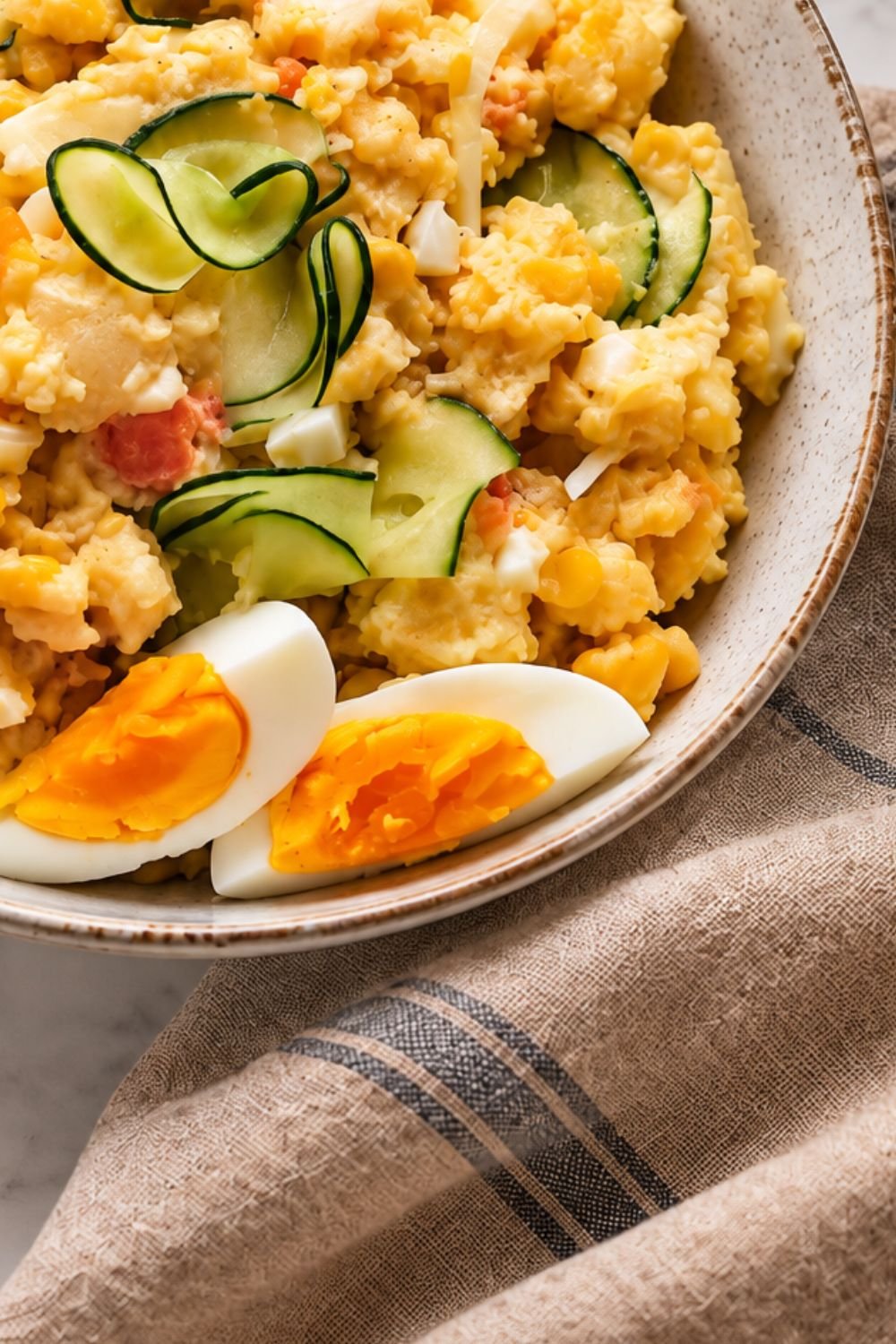
A good japanese potato salad is defined by that contrast: a cool, savoury, faintly tangy mash carrying sweet corn, crisp carrot and soft egg, with just enough mayonnaise to hold the whole thing together.
Frequently Asked Questions
My potatoes turned out gluey and stretchy after mashing. What went wrong, and can I do anything to save the batch?
You mashed past the point where the starch granules stayed intact. Once they rupture, they release long starch chains that turn the texture elastic and paste-like, and no amount of mixing undoes it. There’s no real fix mid-batch, so treat it as a lesson for next time: use a hand masher rather than a processor, work in short bursts, and stop the moment the mash looks broadly uniform with a few visible pieces still holding shape.
I don’t have dashi powder in the cupboard. Can I use regular stock powder instead, and will the salad still taste right?
Stock powder is listed alongside dashi in this recipe, so it’s a genuine option rather than a compromise. What changes is the character of the savouriness. Dashi brings a clean, marine umami from kombu and bonito, while chicken or vegetable stock powder reads warmer and rounder. Either seasons the mash properly and gives you a salad that tastes savoury rather than plain. Add it to the hot potatoes exactly as written, since both need residual heat to dissolve evenly.
How far ahead can I make this, and does anything suffer if it sits in the fridge before serving?
The recipe says to serve immediately once the mix-ins go in, so that’s the intended finish. If you want a head start, split the method: boil, mash, season and chill the potato base ahead of time, keeping it covered, then fold in the eggs, corn, onion, carrot, ham and mayonnaise just before serving. That way the raw onion and carrot keep their bite and the corn stays sweet, rather than softening and releasing moisture into the mash.
Conclusion
What stays with you about japanese potato salad is how much flavour lives inside the potato itself. The dashi and rice vinegar go in while the mash is still hot and steaming, so the seasoning works its way through the base rather than sitting on top of it. By the time the mayonnaise arrives, it only has to bind and enrich, which is why the finished salad tastes creamy without tipping into heavy. Around that soft, savoury foundation you get sweet corn, crisp raw carrot, sharp onion and soft chopped egg, each pulling the texture in a different direction. Ten minutes of boiling, one bowl, and a patient stint in the refrigerator is all it takes to get there.