

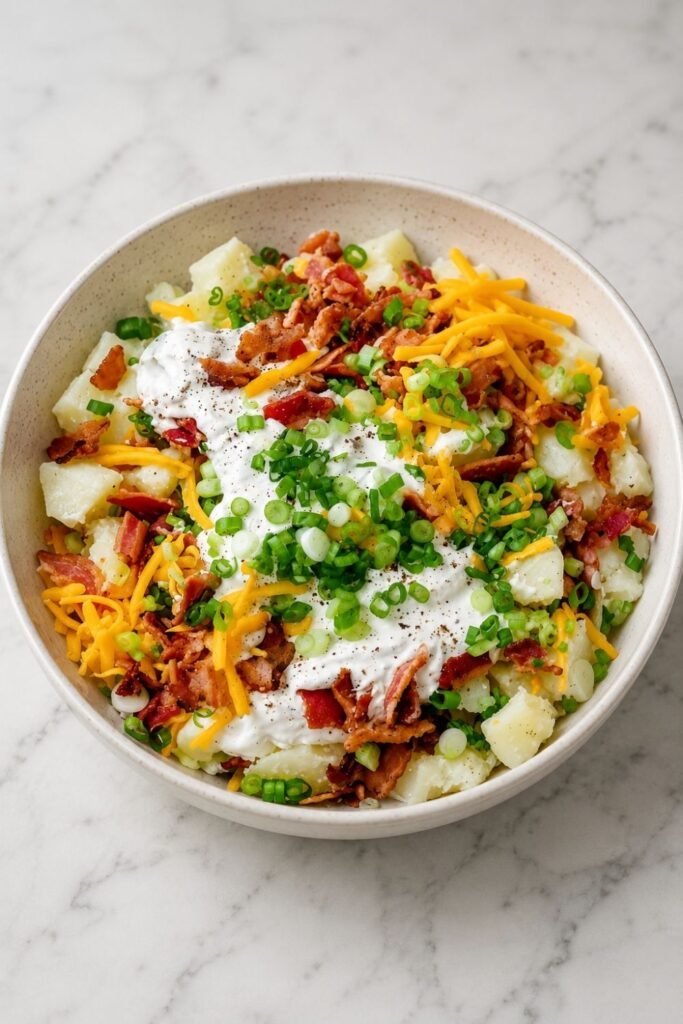
The potatoes get baked, not boiled. That decision drives everything else about this loaded potato salad. Whole russets go into a 400°F oven for 50 to 60 minutes, which drives moisture out instead of pushing it in, and what you end up with is a fluffy, concentrated potato flavor that a pot of water simply can’t deliver.
It also means the potatoes crumble when you cut them, and the recipe treats that as a feature rather than a problem. Those shaggy, broken edges are what grab hold of the mayonnaise and sour cream dressing, giving you a salad that’s creamy throughout instead of chunks sitting in sauce.
The loaded part comes from the same trio that tops a baked potato: 12 ounces of bacon, a cup and a half of shredded cheddar, and six chopped green onions. A splash of apple cider vinegar on the warm potatoes keeps all that richness from becoming one-note.
Here’s what this method gets you.
- Baking the potatoes concentrates their flavor instead of waterlogging them
- Vinegar hits the potatoes while they’re warm, which is when they actually absorb it
- Crumbly russet edges hold the creamy dressing rather than letting it slide off
- Bacon, cheddar, and green onion make it taste like a loaded baked potato in salad form
- It’s designed to be made ahead, needing at least 3 hours in the fridge before serving
- Keeps in the refrigerator for up to 4 days
Why These Potatoes Go In The Oven
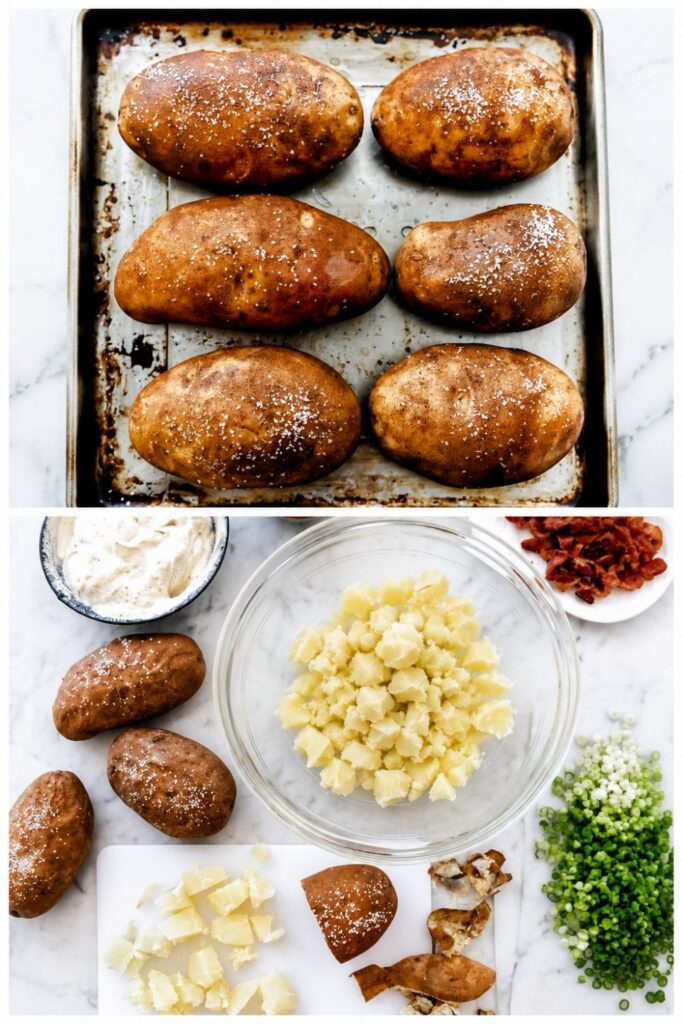
Boiling a potato means submerging a starchy, absorbent thing in water for twenty minutes. Some of that water goes in, and some of the potato’s own flavor leaches out into the pot. For most potato salads that’s an acceptable trade, because a waxy potato holds its shape and the dressing does the flavoring.
Russets are a different animal. They’re high in starch and low in moisture, and boiling them tends to produce something waterlogged and prone to falling apart into a wet mess. Baking pushes them the other way. Moisture evaporates through the skin over 50 to 60 minutes, the starch granules swell and go fluffy, and the flavor concentrates rather than diluting.
That’s why the potatoes get pierced 4 to 5 times with a fork before they go in. Those holes are steam vents. Without them, moisture builds inside a sealed skin, and a potato under pressure can split violently in the oven.
The light coat of olive oil and sprinkle of kosher salt on the outside does two jobs. It helps the skin crisp and it seasons the surface of the flesh underneath, which matters even though the jackets get discarded later.
The Ingredients Carrying The Weight
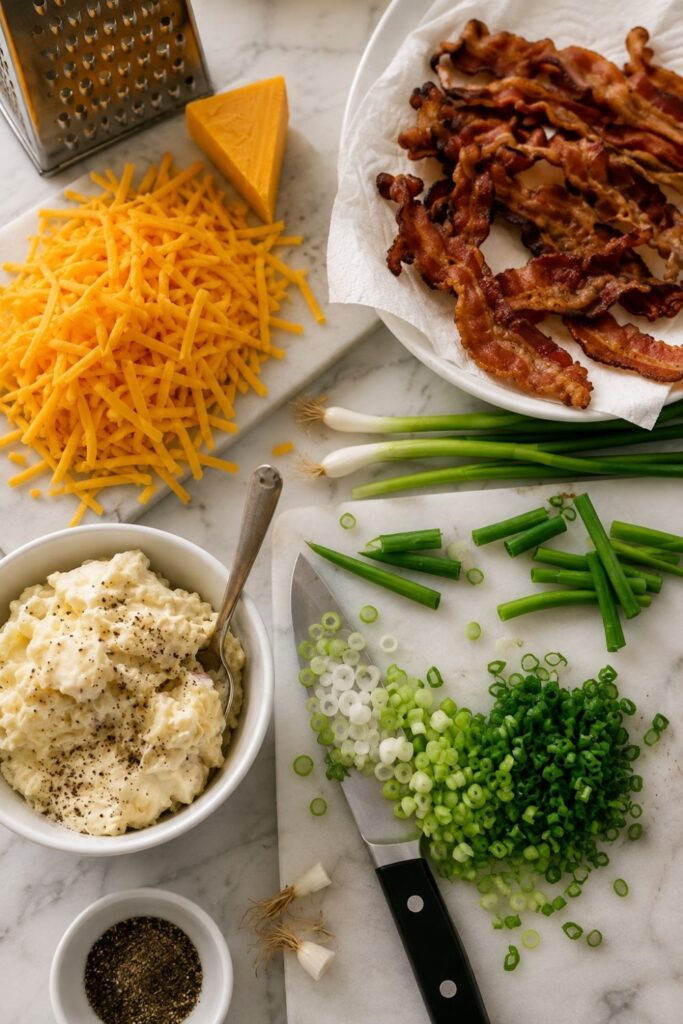
Nine ingredients, and the interesting ones aren’t the obvious ones. The vinegar and the potato variety shape this salad more than the bacon does.
- Russet potatoes: High starch, low moisture. They bake to a fluffy interior and break into shaggy pieces when cut, which is exactly the texture that holds a creamy dressing.
- Apple cider vinegar: The most important 3 tablespoons in the recipe. Acid seasons the potato from the inside and gives the mayonnaise and sour cream something to push against, so the salad tastes bright instead of heavy.
- Mayonnaise: The structural base of the dressing. Its emulsified oil coats every crumbly surface and gives the salad its body.
- Sour cream or Greek yogurt: Thinner and tangier than mayonnaise, it loosens the dressing to a foldable consistency and adds a lactic sharpness. Greek yogurt swaps in cleanly and pushes the tang further.
- Bacon: Salt, smoke, and the one genuinely chewy element in a soft bowl. Twelve ounces is a substantial amount, distributed rather than scattered on top.
- Medium cheddar: Sharp enough to register against the creamy base, mild enough not to overwhelm it. Shredded rather than cubed so it disperses evenly.
- Green onions: Fresh, mild allium bite with none of the aggression of raw white onion, plus color against an otherwise beige bowl.
- Kosher salt and black pepper: Seasoned into the dressing first, then adjusted again after folding. Potatoes absorb an enormous amount of salt, so a second pass is genuinely necessary.
The mayonnaise and sour cream ratio is worth noting. At 1 cup to ¾ cup, this leans slightly toward mayonnaise for structure while keeping enough sour cream to stay tangy and spoonable. Pure mayonnaise would be dense, and pure sour cream would be thin and would break down against the vinegar.
The Vinegar Step Is The Real Technique
Read step one again carefully. The potatoes get peeled, cut, and transferred to a bowl, and then the vinegar goes on while they’re still warm, followed by a 15 to 30 minute rest.
This is the step most people would skip, and it’s the one that separates this from an ordinary creamy potato salad.
Warm potato flesh is porous. The starch has gelatinized during baking and hasn’t yet retrograded, meaning the structure is open and receptive. Vinegar poured on at this stage moves into the potato rather than pooling around it. By the time the potatoes have cooled, the acid is distributed through the interior of every piece.
Do the same thing to cold potatoes and the vinegar mostly sits on the outside. You’d taste sharp acidity on the surface of some pieces and nothing in others, instead of an evenly seasoned salad.
The rest period matters for a second reason. The potatoes need to be cool before the dressing goes on. Mayonnaise added to warm potato can loosen and turn greasy as the oil emulsion breaks down under heat, and warm cheddar folded into a bowl would melt into strings rather than staying as distinct shreds.
Embracing The Crumble
The recipe says the potato flesh may crumble and get shaggy, and that this is okay. That instruction deserves more attention than it usually gets.
There’s a strong instinct to want neat cubes in a potato salad. With baked russets, chasing that neatness works against you. The flesh is fluffy and structurally loose after an hour in the oven, and trying to cut perfect 1-inch cubes will just frustrate you while producing a lot of broken pieces anyway.
Those broken pieces are doing useful work. A smooth-sided cube has minimal surface area for dressing to cling to, so it sits in the sauce. A shaggy, torn piece has enormous surface area, with crevices and rough faces that trap mayonnaise and sour cream. That’s what makes each bite creamy all the way through.
So cut into 1-inch chunks, transfer everything to the bowl including the crumbled bits, and let the texture be uneven. Discard the jackets and move on.
The Folding Step
When the potatoes are cool, everything goes in at once: the mayonnaise mixture, the crumbled bacon, the green onion, and the cheddar. Then you fold, gently.
Folding is a specific motion, not a gentler version of stirring. Slide a wide spatula down the side of the bowl, sweep across the bottom, and lift the mixture over on itself, then rotate the bowl a quarter turn and repeat. You’re moving ingredients from the bottom to the top rather than dragging them in circles.
Stirring vigorously would break the already-fragile potato pieces down into paste. You’d lose the distinction between chunk and dressing entirely, and end up with something closer to mashed potato with bacon in it.
Stop when the dressing is evenly distributed and you can still see distinct potato pieces. Then season with more salt and pepper to taste, and taste it properly before you commit.
Why It Needs Hours In The Fridge
Three hours sounds like a long time for a salad that’s already assembled, but the wait does measurable work.
Freshly mixed, the components are still separate. Mayonnaise tastes like mayonnaise, bacon tastes like bacon, and the vinegar sits somewhere in the background. As the salad chills, the dressing thickens and grips the potato, salt continues to distribute, and the bacon and cheddar flavors migrate outward into the base. What was a collection of ingredients becomes a single dish.
The temperature change matters too. This is a cold salad, and cold is part of how it’s meant to taste. A room-temperature version reads as much richer and heavier, because chilling mutes the perception of fat.
Overnight works fine and arguably improves it. Made the day before, this is one less thing to handle on the day you’re serving it. It stores in the refrigerator for up to 4 days.
Ingredients
The list separates into the potato base, the creamy dressing, and the loaded add-ins. The vinegar is the item to pay closest attention to, since when it’s added matters as much as how much.
- 4 pounds russet potatoes choose similar sizes so they bake evenly
- 1-2 tablespoons olive oil
- 3 tablespoons apple cider vinegar goes on while the potatoes are still warm
- 1 cup mayonnaise
- ¾ cup sour cream, or Greek yogurt
- 1 teaspoon kosher salt
- 1 teaspoon freshly ground black pepper
- 12 ounces bacon, cooked, cooled and chopped
- 6 green onions, chopped
- 1 ½ cups medium cheddar cheese, shredded
Additional kosher salt and pepper are needed at the end for seasoning to taste.
Instructions
The potatoes need to cool fully before the dressing goes on, so use the rest period to prep everything else.
- Bake the potatoes. Preheat the oven to 400°F. Put the cleaned potatoes on a baking sheet and pierce each one 4 to 5 times with a fork so steam can escape. Coat them lightly with olive oil, sprinkle with kosher salt, and cook for 50 to 60 minutes, until a cake tester or skewer slides in easily. Take them out and let them cool for 5 minutes.
- Peel, cut, and splash with vinegar. Once they’re cool enough to handle, peel the potatoes and cut them into 1-inch chunks, discarding the jackets. The flesh may crumble and get shaggy, which is fine, so transfer all of it to a large mixing bowl. While the potatoes are still warm, sprinkle them with the apple cider vinegar and let them rest for 15 to 30 minutes, or until cooled.
- Cook the bacon. Meanwhile, cook the bacon in a large skillet or in the oven, drain it, and let it cool. Crumble it into bite-size pieces.
- Mix the dressing. In a small bowl, combine the mayonnaise and sour cream, then season with the kosher salt and pepper.
- Fold everything together. When the potatoes are cool, pour the mayonnaise mixture over them along with the crumbled bacon, green onion, and cheddar cheese. Fold the ingredients together gently, lifting from the bottom rather than stirring, so the potato pieces stay intact. Season with more salt and pepper to taste.
- Chill before serving. Refrigerate for 3 hours up to overnight before serving. Store in the refrigerator for up to 4 days.
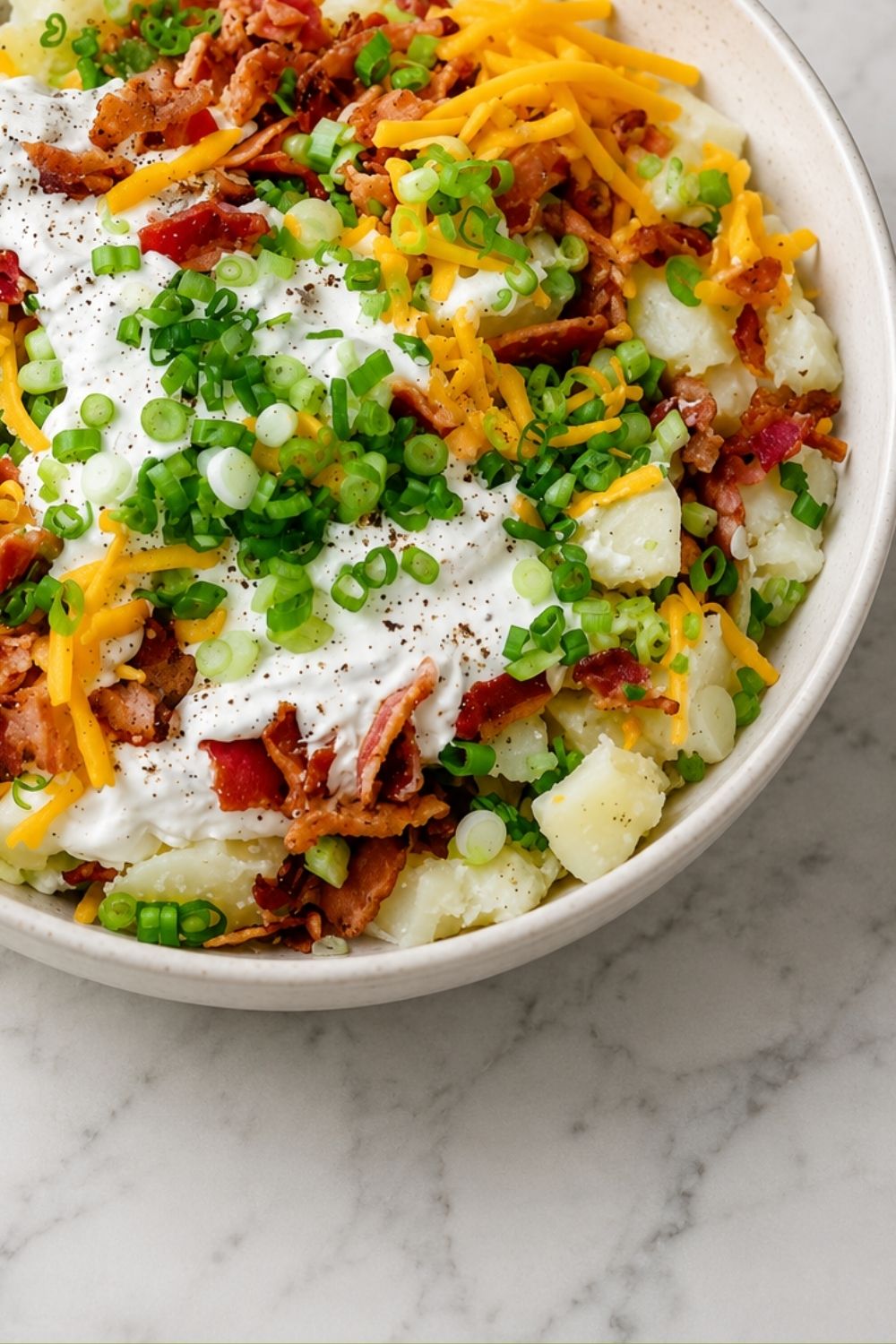
Loaded Potato Salad
Ingredients
Method
- Bake the potatoes. Preheat the oven to 400°F. Put the cleaned potatoes on a baking sheet and pierce each one 4 to 5 times with a fork so steam can escape. Coat them lightly with olive oil, sprinkle with kosher salt, and cook for 50 to 60 minutes, until a cake tester or skewer slides in easily. Take them out and let them cool for 5 minutes.
- Peel, cut, and splash with vinegar. Once they’re cool enough to handle, peel the potatoes and cut them into 1-inch chunks, discarding the jackets. The flesh may crumble and get shaggy, which is fine, so transfer all of it to a large mixing bowl. While the potatoes are still warm, sprinkle them with the apple cider vinegar and let them rest for 15 to 30 minutes, or until cooled.
- Cook the bacon. Meanwhile, cook the bacon in a large skillet or in the oven, drain it, and let it cool. Crumble it into bite-size pieces.
- Mix the dressing. In a small bowl, combine the mayonnaise and sour cream, then season with the kosher salt and pepper.
- Fold everything together. When the potatoes are cool, pour the mayonnaise mixture over them along with the crumbled bacon, green onion, and cheddar cheese. Fold the ingredients together gently, lifting from the bottom rather than stirring, so the potato pieces stay intact. Season with more salt and pepper to taste.
- Chill before serving. Refrigerate for 3 hours up to overnight before serving. Store in the refrigerator for up to 4 days.
Notes
Recipe Notes
A few practical points worth knowing before you start.
This is built for making ahead. The minimum 3 hour chill means it can’t be a last-minute dish, and overnight is a legitimate option that takes it off your list entirely on serving day.
Greek yogurt is given as a direct alternative to sour cream in the ingredient list. It brings more tang and a slightly thicker consistency, so expect a sharper result.
Pick russets of roughly similar size for the baking sheet. Four pounds of mixed small and large potatoes will finish at different points across the 50 to 60 minute window, and you’ll be checking them individually.
The recipe seasons twice, once in the dressing and once after folding. Both are necessary. Four pounds of potato absorbs far more salt than you’d expect, and the taste right after folding is the reliable one.
Questions Worth Answering
Why add the vinegar while the potatoes are still warm?
Warm potato flesh is porous, because the starch granules have swelled during baking and haven’t yet tightened back up. In that state the potato absorbs liquid readily, so the 3 tablespoons of apple cider vinegar travel into the interior of every piece during the 15 to 30 minute rest instead of sitting on the surface. Add it to cooled potatoes and you get sharp hits of acid on some pieces and nothing on others. That distributed acidity is what keeps the salad tasting bright despite a cup of mayonnaise and ¾ cup of sour cream.
Can I boil the potatoes instead of baking them?
You can, but you’d be working against the recipe. Russets are high in starch and low in moisture, and 50 to 60 minutes at 400°F drives moisture out and concentrates the flavor. Boiling pushes water into an already absorbent potato and leaches some flavor into the pot, which tends to give you a waterlogged, sloppy result that dilutes the dressing. The shaggy crumbled edges you get from cutting baked potatoes are also what grab the mayonnaise and sour cream mixture, so the texture would change as much as the taste.
How far ahead can I make this, and why does it need so long in the fridge?
Three hours is the minimum and overnight is fine, which makes this a genuine make-ahead dish that keeps for up to 4 days. Straight after folding, the components still taste separate, and the chilling time is when the dressing thickens and grips the potato, the salt distributes through 4 pounds of starch, and the bacon and cheddar flavors migrate into the creamy base. Cold also mutes the perception of fat, so a properly chilled bowl tastes balanced where a room-temperature one tastes heavy. If it seems flat right after mixing, that’s expected.
Conclusion
Cold, creamy, and genuinely loaded with bacon, cheddar, and green onion, this tastes like the baked potato it started as. The oven does the heavy lifting, the vinegar seasons from the inside, and the fridge does the rest while you get on with something else. Make it the night before and it’ll be better for the wait.