

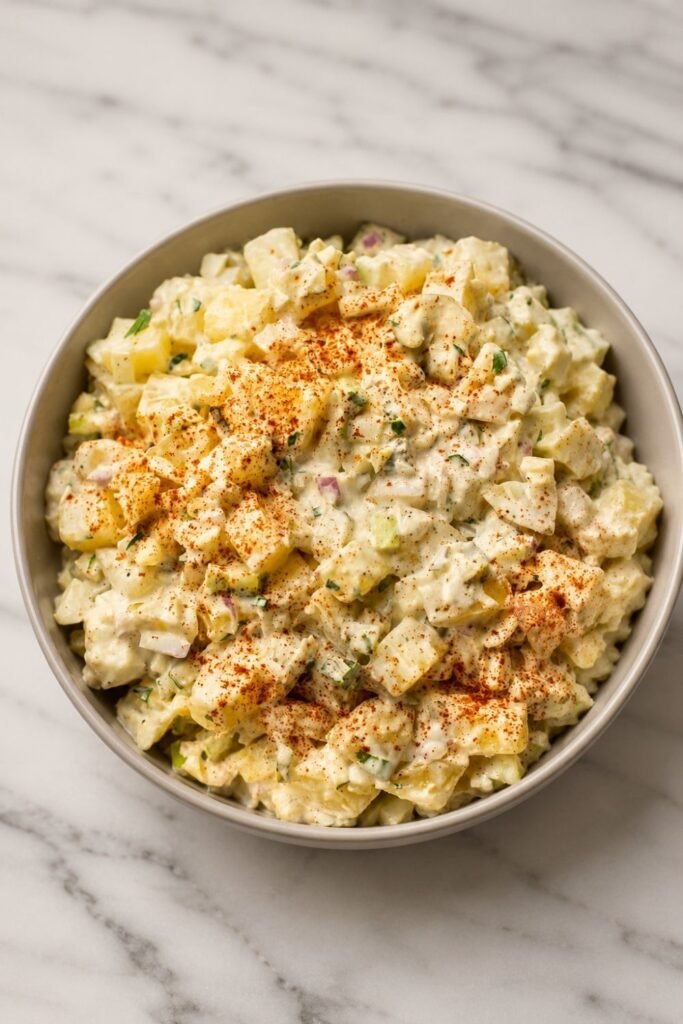
Most potato salad gets all of its seasoning from the dressing, which is why so much of it tastes bland in the middle and heavy on the outside. This potato salad with egg takes a different route. The drained potatoes get a tablespoon of white vinegar while they’re still hot, so the tang works its way into the pieces before the mayo ever touches them. By the time the dressing goes on, the potatoes are already seasoned from the inside.
The result is creamy without feeling greasy, with a sharp pickle and Dijon backbone cutting through the mayo. Chopped hard-boiled eggs add richness, celery and red onion keep the texture from going soft, and dill pickles bring both crunch and acidity. It’s the kind of salad that tastes better after an hour in the fridge, though it’s honestly good while it’s still slightly warm.
Here’s what sets this version apart from the standard bowl of mayo and potatoes.
- Hot potatoes soak up the vinegar, so the seasoning reaches the centre of every piece
- Yukon Golds turn creamy without collapsing, so the salad stays chunky rather than mashed
- Pickle juice, Dijon, and Worcestershire give the mayo a sharp, savoury edge instead of plain richness
- Three separate crunchy elements keep the texture interesting all the way through the bowl
- The potatoes and eggs cook at the same time, so nothing sits around waiting
The Ingredients That Decide the Texture
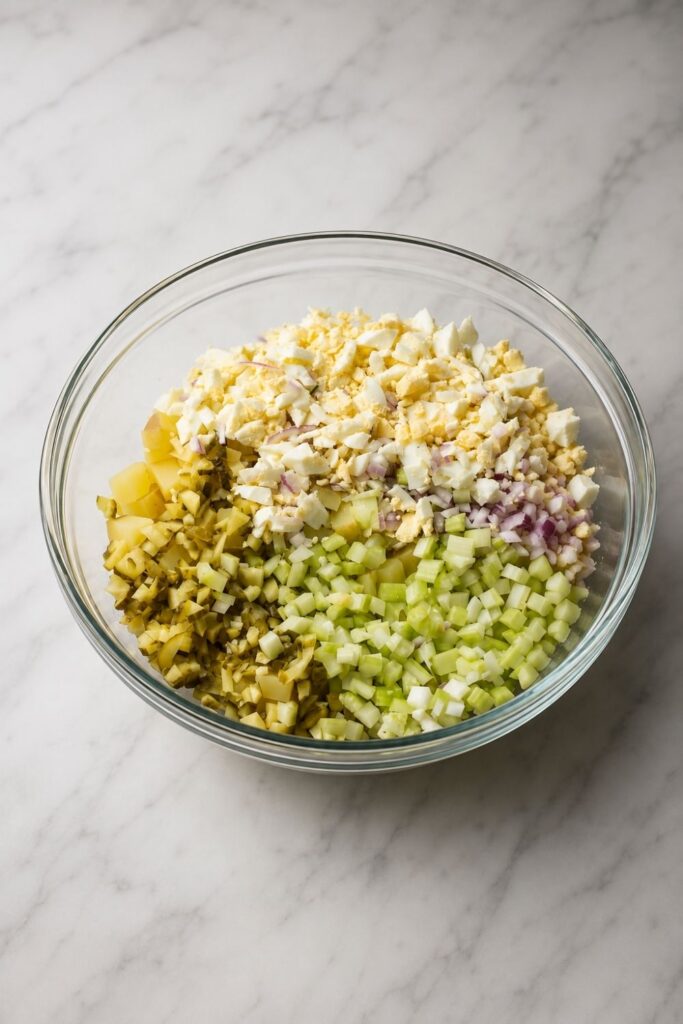
A potato salad has very few moving parts, which means each one carries real weight. The difference between a bowl that holds its shape and a bowl of seasoned mash comes down to which potato you use and how you treat it once it’s drained.
The dressing ingredients matter for a different reason. Mayo on its own is rich but flat, and the sharp additions are what stop the salad from feeling one-note after the second forkful.
- Yukon Gold potatoes: They sit between waxy and floury, so they turn creamy at the edges while the pieces stay intact. Their thin skins also mean you can leave them on without anything turning tough or papery.
- White vinegar (the tablespoon on its own): This one isn’t part of the dressing. Hot potatoes take on liquid far more readily than cold ones, so this is your only chance to season the inside of each piece rather than just the surface.
- Mayo: It coats the potatoes and carries every other flavour in the dressing. It also relies on staying emulsified, which is why the temperature of the potatoes matters so much later on.
- Dijon mustard: It adds a low, mustardy heat, and it helps the dressing hold together as a smooth mixture rather than separating into mayo and liquid.
- Pickle juice: Straight acidity with the dill flavour already built in. It thins the mayo just enough to coat everything evenly instead of sitting in thick clumps.
- Celery salt: This is doing double duty as your seasoning and as a flavour that echoes the chopped celery. Since the cooking water goes unsalted, most of the salt in the finished salad comes from here and from the pickles.
- Worcestershire sauce: Listed as optional, but it adds a savoury depth that’s hard to place and easy to miss when it’s gone. A teaspoon won’t make the salad taste of Worcestershire.
- Eggs, celery, pickles, and red onion: The eggs bring softness and richness, while the other three supply the crunch. Chopping the onion small keeps its bite spread evenly rather than concentrated in a few mouthfuls.
Why the Vinegar Goes On While the Potatoes Are Warm
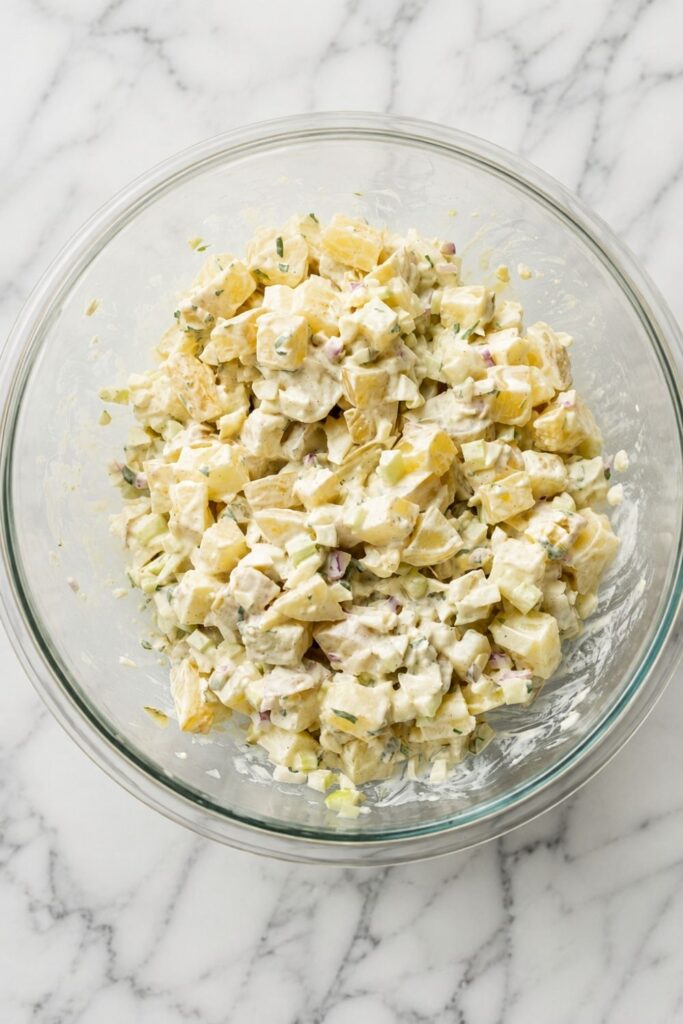
This is the step that separates good potato salad from forgettable potato salad, and it takes about ten seconds. As soon as the potatoes are drained, they go back into the hot pot, get a tablespoon of white vinegar drizzled over them, and get tossed gently.
Hot potatoes are still steaming and still releasing moisture, and their starch has swollen and softened during cooking. Add liquid at that point and it gets drawn in rather than running off. Wait until they’re cold and that same vinegar will sit on the surface and taste sharp instead of seasoning anything.
You’ll see the vinegar disappear almost immediately, and the potatoes will look slightly matte rather than wet. That’s the sign it’s gone where you want it. Toss with two spoons rather than stirring with one, lifting from underneath instead of dragging through the pile, because the pieces are at their most fragile right now.
Skip this step and you’ll notice it in the finished bowl. The salad will taste rich around the outside of each piece and plain in the middle, and you’ll end up adding more dressing to compensate.
How the Timing Fits Together
Everything in this recipe overlaps, which keeps the total time down considerably. Once you understand the shape of it, you can move through the whole thing without checking the steps constantly.
The potatoes and eggs go on to boil at the same time in separate pots. While both are cooking, you mix the dressing and put it in the fridge, so it’s cold and waiting when you need it. The eggs come out to cool under running water, and the potatoes get drained, dressed with vinegar, and left to cool for twenty minutes.
That twenty minute window is your chopping time. Pickles, celery, onions, and the peeled eggs all get cut while the potatoes lose their heat, so nothing is sitting idle. Then everything meets in one large bowl and gets tossed together.
The one thing worth watching is the potatoes, since they’re the only component with a real window. Start testing with the tip of a knife at the eight minute mark and you won’t overshoot.
How to Stop the Potatoes Turning to Mush
Two things break a potato salad, and both of them happen before the dressing goes near the bowl.
The first is overcooking. Simmering runs eight to ten minutes from the point the water reaches a boil, and a knife should slide into a piece with only slight resistance. If the potato falls apart as you pull the knife out, they’ve gone too far. Cutting the pieces to a similar size in the first place is what makes this test reliable, because otherwise the small pieces are already collapsing while the big ones are still firm.
The second is dressing potatoes that are still hot. Hot potatoes will thin the mayo, and the dressing will slide off into a loose pool at the bottom of the bowl instead of clinging to each piece. That’s what the twenty minute cooling period is for. The potatoes will still feel warm to the touch at the end of it, which is exactly right.
Gently tossing them once or twice during those twenty minutes gets air moving between the pieces and speeds up the cooling. It also stops the layer at the bottom of the pot from steaming itself soft under the weight of everything above it.
What Gives the Dressing Its Sharpness
The dressing is mixed in a small bowl and refrigerated while the potatoes and eggs cook, which means it comes together early and gets a head start on the flavours settling.
It’s built on three-quarters of a cup of mayo, but the four sharp additions are what make it taste like something. Pickle juice and white vinegar bring straight acidity, Dijon adds mustard heat and helps everything stay smooth, and Worcestershire sits underneath adding savouriness. Celery salt and pepper handle the seasoning, and chopped parsley adds a fresh, slightly grassy note that lifts the whole mixture.
Mix until it’s smooth and evenly coloured, with no streaks of mustard or pale patches of unmixed mayo. It should look thick but pourable, closer to the consistency of a thick pancake batter than a paste. Chilling it also thickens it very slightly, so it clings better when it hits the potatoes.
What You’ll Need
Everything here is straightforward, but pay attention to the two separate quantities of white vinegar. One tablespoon goes on the warm potatoes and one teaspoon goes into the dressing, and they’re doing completely different jobs.
- Yukon Gold potatoes, diced: 2 pounds peeling is optional, the skins are thin enough to leave on
- Eggs: 3
- White vinegar: 1 tablespoon this is the one that goes on the warm potatoes, not in the dressing
- Dill pickles, chopped: 1/2 cup
- Celery, chopped: 2 sticks
- Red onion, chopped small: 1/4 cup
- Paprika: to taste (optional) for sprinkling over the top at the end
- Mayo: 3/4 cup
- Celery salt: 1/2 teaspoon
- Worcestershire sauce: 1 teaspoon optional but recommended
- Dijon mustard: 1 teaspoon
- White vinegar: 1 teaspoon
- Pickle juice: 1 tablespoon straight from the jar of dill pickles
- Fresh parsley, chopped: 1 tablespoon
- Pepper: to taste
How to Make It
Read through the first three steps before you start, since the potatoes, eggs, and dressing all happen at once.
- Cut and cover the potatoes. Dice the potatoes into small bite-size pieces, keeping them roughly the same size so they cook at the same rate. Leave the skins on or peel them, whichever you prefer. Put them in a large pot with enough water to cover them by 1 inch, and don’t salt the water.
- Simmer until tender. Bring the pot to a boil over medium-high heat, then turn the heat down and let the potatoes simmer for about 8 to 10 minutes from the moment they started boiling. They’re ready when a knife tip slides into a piece with only light resistance.
- Hard-boil the eggs alongside. While the potatoes cook, boil the eggs in a separate pot, timing 10 minutes from the point they start to boil. Run cold water over them for a few minutes to cool them, then peel once they’re cool enough to handle.
- Mix and chill the dressing. Combine the mayo, celery salt, Worcestershire, Dijon, white vinegar, pickle juice, parsley, and pepper in a small bowl and stir until completely smooth with no streaks. Put it in the fridge until you need it.
- Drain and season with vinegar. Drain the cooked potatoes thoroughly and tip them back into the pot they cooked in. Drizzle over the 1 tablespoon of white vinegar and toss gently with two spoons, lifting rather than stirring so the pieces stay whole.
- Cool for 20 minutes. Leave the potatoes to cool for 20 minutes, tossing them gently a couple of times to get air circulating and speed things up. They should still be warm at the end, just not hot enough to thin the dressing.
- Chop everything else. While the potatoes cool, chop the pickles, celery, onions, and the peeled eggs. Keeping the onion small matters more than the others, since large pieces come through sharply.
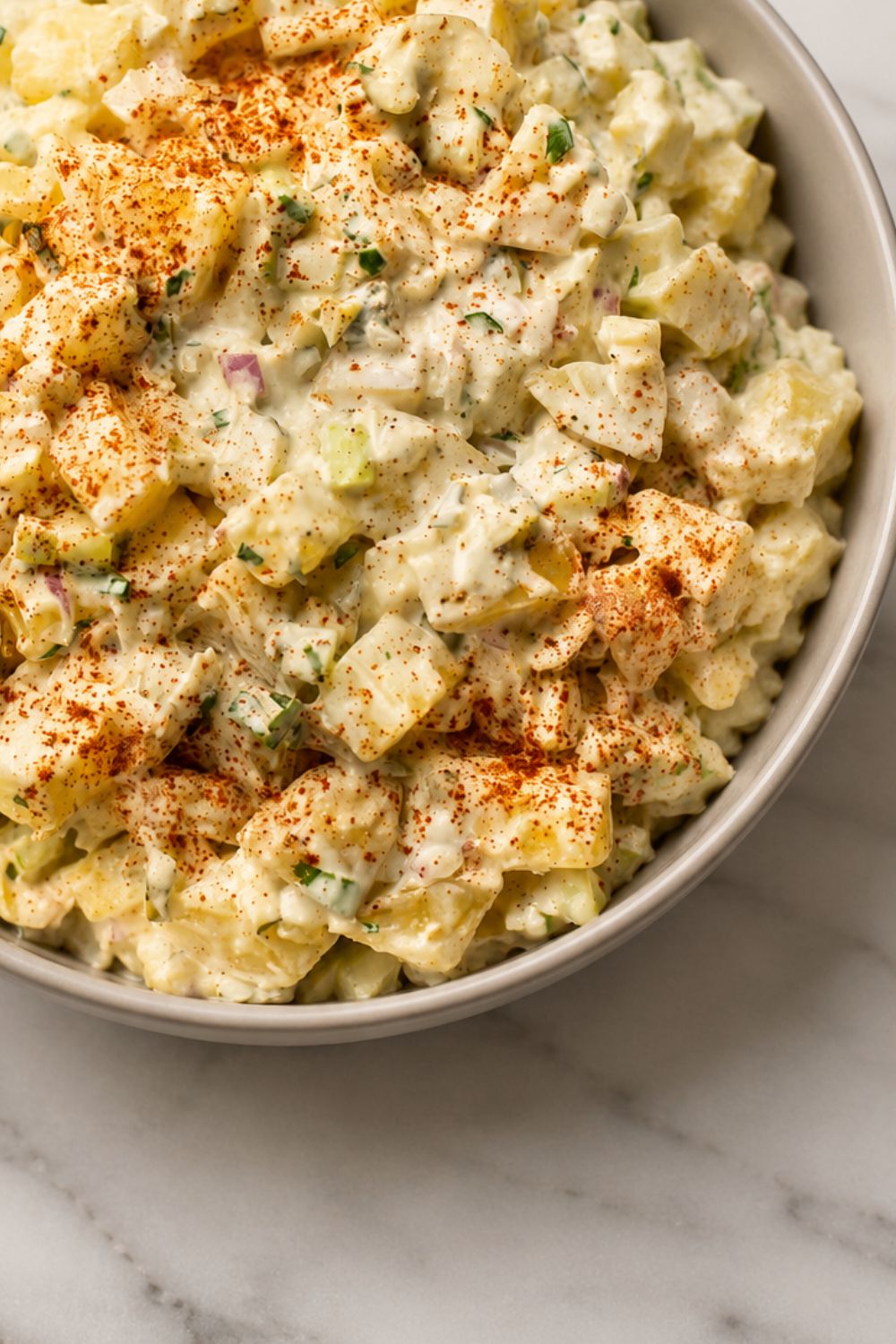
- Toss and finish. Add the warm potatoes to a large salad bowl with the chopped ingredients and the dressing, then toss until everything is coated. Sprinkle paprika over the top if you like. Eat it right away while it’s still warm, or cover the bowl tightly and chill it for an hour or two so the flavours settle together.
Potato Salad With Egg
Ingredients
Method
- Cut and cover the potatoes. Dice the potatoes into small bite-size pieces, keeping them roughly the same size so they cook at the same rate. Leave the skins on or peel them, whichever you prefer. Put them in a large pot with enough water to cover them by 1 inch, and don’t salt the water.
- Simmer until tender. Bring the pot to a boil over medium-high heat, then turn the heat down and let the potatoes simmer for about 8 to 10 minutes from the moment they started boiling. They’re ready when a knife tip slides into a piece with only light resistance.
- Hard-boil the eggs alongside. While the potatoes cook, boil the eggs in a separate pot, timing 10 minutes from the point they start to boil. Run cold water over them for a few minutes to cool them, then peel once they’re cool enough to handle.
- Mix and chill the dressing. Combine the mayo, celery salt, Worcestershire, Dijon, white vinegar, pickle juice, parsley, and pepper in a small bowl and stir until completely smooth with no streaks. Put it in the fridge until you need it.
- Drain and season with vinegar. Drain the cooked potatoes thoroughly and tip them back into the pot they cooked in. Drizzle over the 1 tablespoon of white vinegar and toss gently with two spoons, lifting rather than stirring so the pieces stay whole.
- Cool for 20 minutes. Leave the potatoes to cool for 20 minutes, tossing them gently a couple of times to get air circulating and speed things up. They should still be warm at the end, just not hot enough to thin the dressing.
- Chop everything else. While the potatoes cool, chop the pickles, celery, onions, and the peeled eggs. Keeping the onion small matters more than the others, since large pieces come through sharply.
- Toss and finish. Add the warm potatoes to a large salad bowl with the chopped ingredients and the dressing, then toss until everything is coated. Sprinkle paprika over the top if you like. Eat it right away while it’s still warm, or cover the bowl tightly and chill it for an hour or two so the flavours settle together.
Notes
Notes on Making It Your Way
A couple of choices in this recipe are genuinely open, and a couple only look like they are.
Serving temperature is the real fork in the road. Straight from the bowl, the salad is warm and the dressing tastes brighter and looser. After an hour or two in the fridge under a tight cover, it firms up, the pickle and Dijan flavours settle into the potatoes, and it tastes more like the version you’d expect at a cookout. Neither is wrong.
The Worcestershire is marked optional, and the salad works without it. It’s worth adding if you have it, because it fills in a savoury gap you’ll notice more by its absence than its presence. The paprika is decorative more than anything, adding colour across the top and a very light warmth.
Since this is a mayo and egg salad, keep it covered and refrigerated whenever it isn’t being served, rather than letting the bowl sit out at room temperature while people go back for seconds.
Common Questions
A few things come up regularly with this style of potato salad.
Do I have to peel the potatoes?
No. Yukon Gold skins are thin and soften completely during boiling, so they blend into the salad rather than standing out. Peel them if you prefer a uniform pale look, and do it before dicing so the pieces stay even.
Why isn’t the cooking water salted?
The seasoning arrives later from the celery salt, the pickles, and the pickle juice, all of which bring salt with them. Salting the water on top of that stacks salt on salt, and the finished salad ends up over-seasoned with no easy way to pull it back.
Can I use a different kind of potato?
Yukon Golds are what this recipe is built around, since they hold their shape while turning creamy. Another waxy potato would be a reasonable thing to try, though the cooking time and the final texture may shift, so treat it as an experiment rather than a straight swap and test with a knife rather than relying on the clock.
Can I make it further ahead than a couple of hours?
The recipe covers chilling for an hour or two before serving, which is the point at which the flavours have properly melded. If you want to make it earlier in the day, keep it tightly covered in the fridge and give it a gentle toss before serving, since the potatoes will absorb some of the dressing as they sit.
My dressing looks thin in the bowl. What happened?
The potatoes were almost certainly still too hot when the dressing went on. Heat loosens mayo, and once it thins it runs off the potatoes and pools underneath. The full 20 minutes of cooling is what prevents it, and the gentle tossing during that time is what makes 20 minutes enough.
Between the creamy Yukon Golds, the crunch from three different vegetables, and a dressing sharp enough to cut through all that mayo, this is potato salad that tastes deliberate rather than assembled. Give it the vinegar while it’s warm and the twenty minutes to cool, and the rest of it takes care of itself.