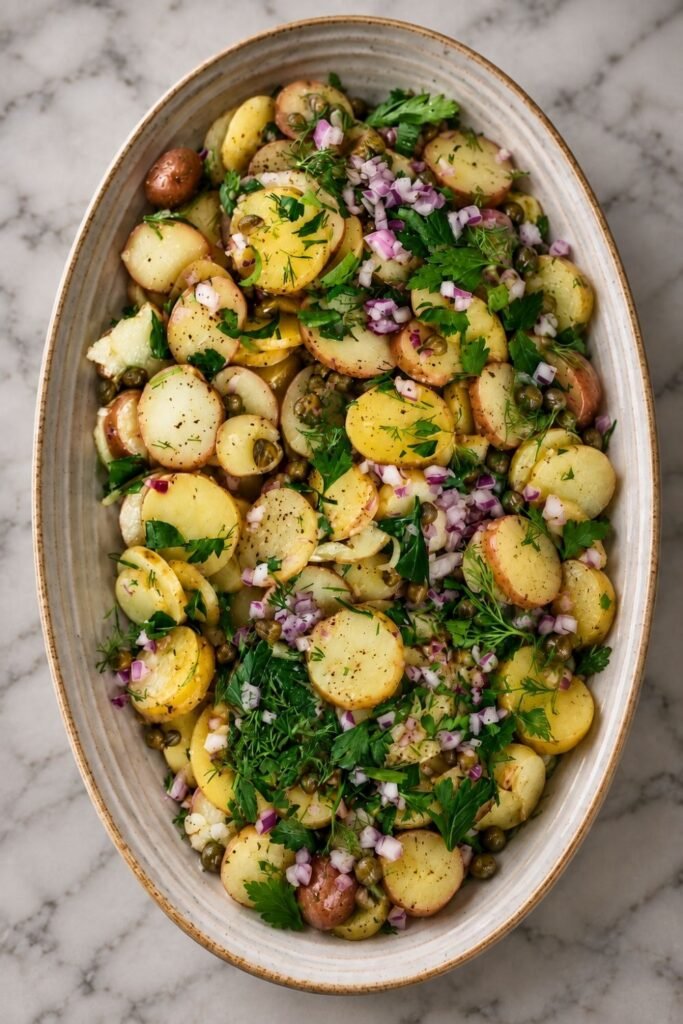


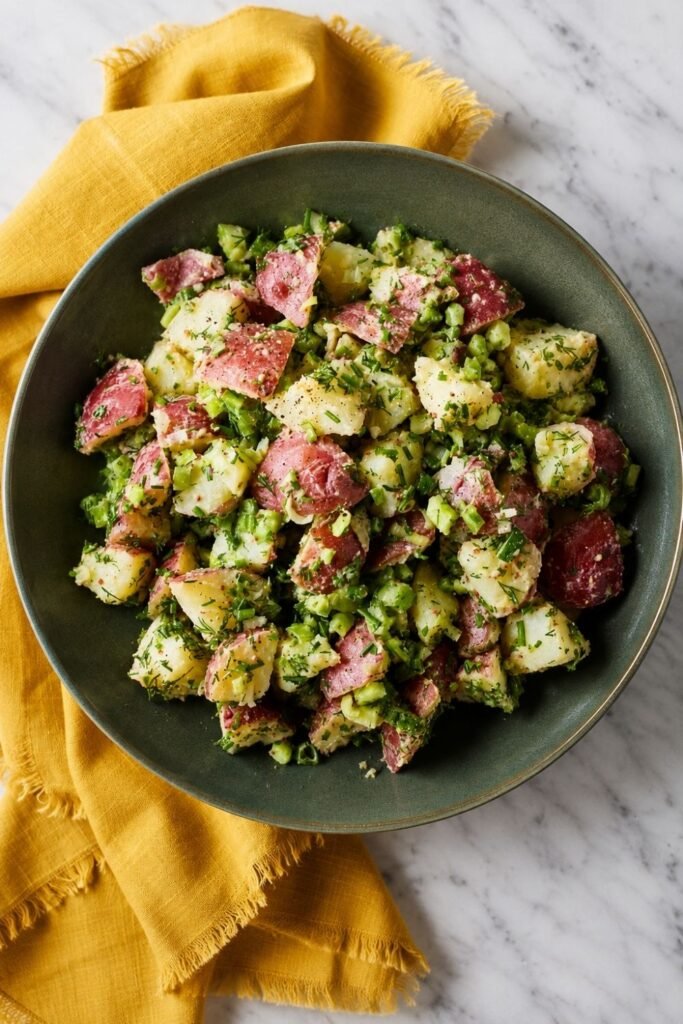
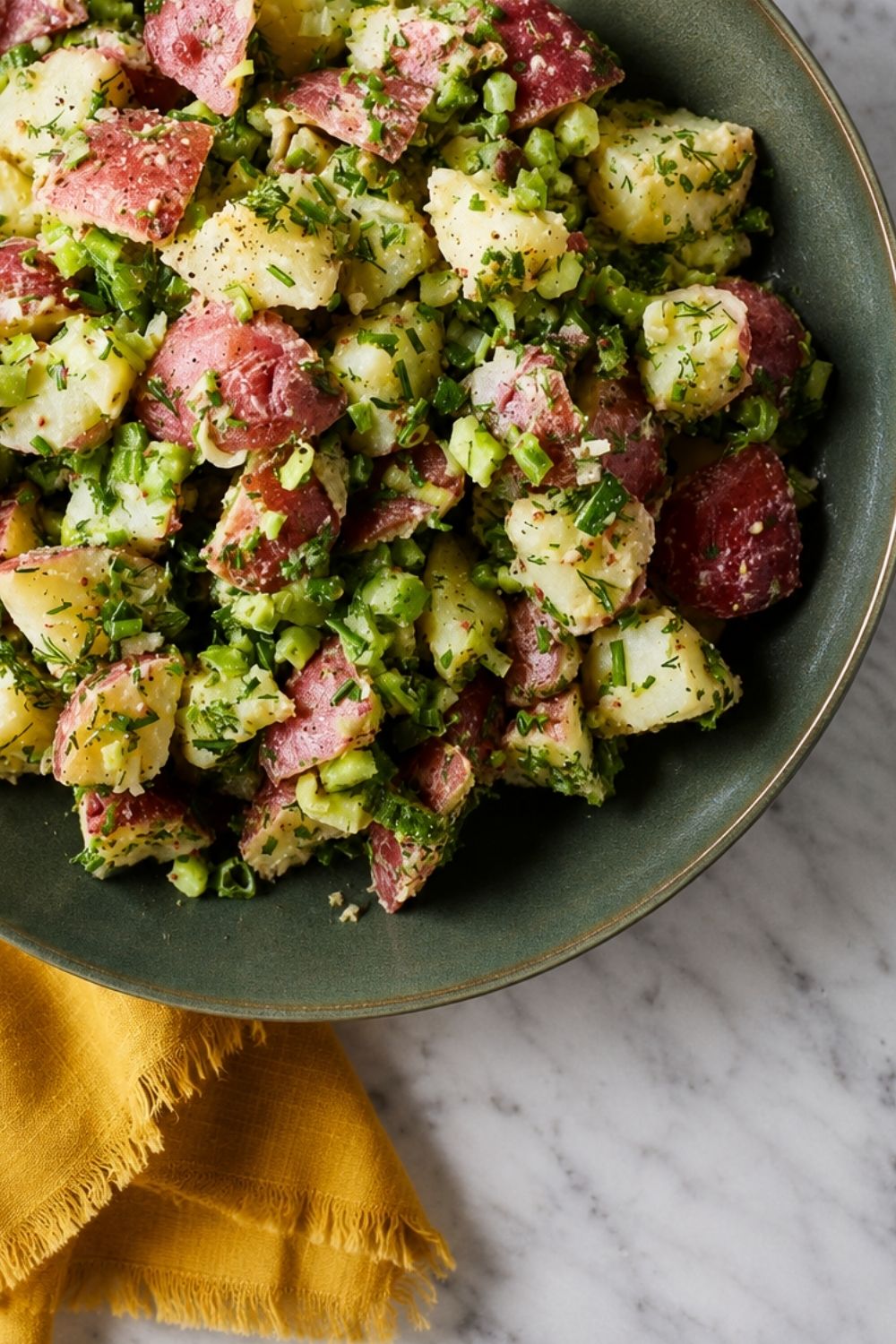
One tablespoon of mayonnaise. That’s the entire creamy element in this bowl, and it changes the character of the dish completely. Instead of a thick, mayonnaise-bound salad, this red potato salad runs on a grainy Dijon vinaigrette built from olive oil, lemon juice, white wine vinegar, and three grated garlic cloves. The mayo is there as an emulsifier and a whisper of richness, not as the base.
Half a cup of chopped fresh herbs goes in, split between chives and dill, along with four chopped celery stalks and three scallions. That’s an unusually high ratio of green, crunchy things to potato, and it’s deliberate. What you get is a salad that tastes fresh and sharp rather than rich and filling.
The potatoes stay unpeeled in 1½-inch chunks, and they only need 5 to 10 minutes of simmering. Everything then chills together for at least an hour so the vinaigrette can work its way into the potato.
Here’s what this approach delivers.
- A grainy Dijon vinaigrette instead of a heavy mayonnaise base, with just 1 tablespoon of mayo
- Red potatoes hold their shape, so you get defined chunks rather than mush
- No peeling required, which cuts a tedious step and keeps the red skins in the bowl
- Celery and scallions bring real crunch against soft potato
- Half a cup of fresh chives and dill makes it taste bright rather than heavy
- The dressing is whisked together in one bowl in under two minutes
Why Red Potatoes Suit This Dressing
Red potatoes are waxy, meaning low starch and high moisture. Their cells stay bound together during cooking instead of swelling and separating, which is why they hold their shape through boiling, draining, and a vigorous stir with dressing.
That matters more than usual here because of what the dressing is. A thick mayonnaise binder can hold broken potato together and disguise a certain amount of crumbling. A thin vinaigrette can’t. If the potato falls apart, you end up with a starchy, cloudy mess rather than glossy coated chunks.
The thin skins are the second advantage. Red potato skins are tender enough to eat without any unpleasant texture, so the recipe never asks you to peel anything. They also hold the chunks together during cooking, acting as a kind of casing around each piece.
Cut into 1½-inch chunks, they’re large enough to stay distinct and small enough to cook through in 5 to 10 minutes of simmering.
The Ingredients Doing The Work
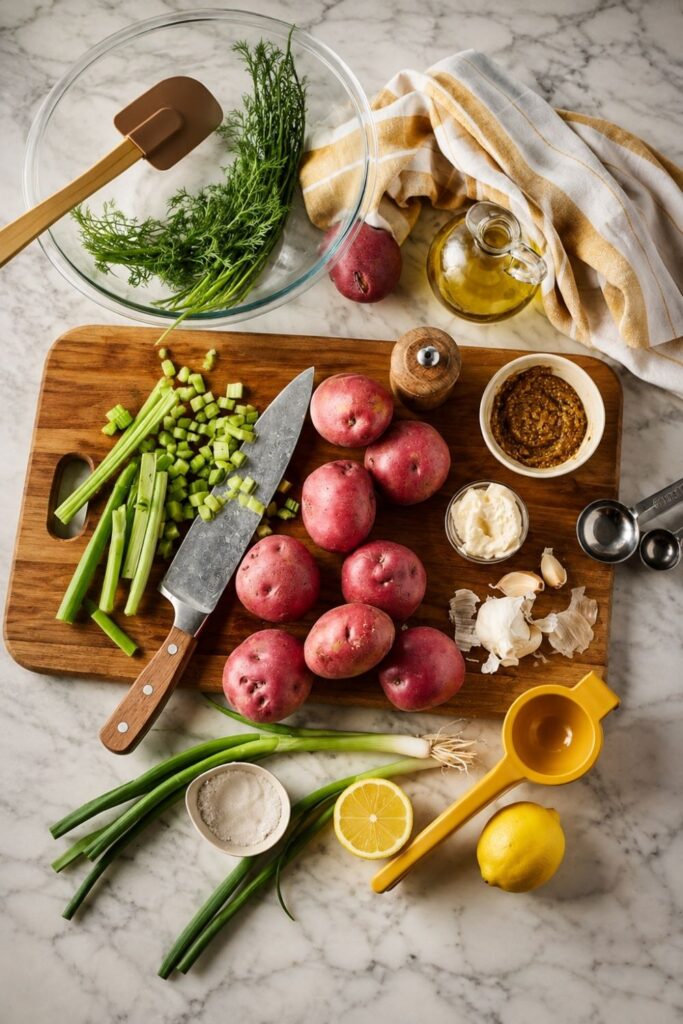
There are a lot of components in this list, but the dressing is where the interesting decisions live. The mustard, the mayonnaise, and the two acids are worth understanding individually.
- Red potatoes: Waxy and low in starch, so they hold their chunks through cooking and stirring. Thin skins mean no peeling and a little extra color in the bowl.
- Grainy Dijon mustard: Doing two jobs at once. Its emulsifying compounds hold the olive oil and acid together, and the whole seeds give little pops of texture and sharp mustard flavor throughout.
- Extra-virgin olive oil: At ⅓ cup this is the bulk of the dressing. Its fruity, peppery character comes through clearly in a vinaigrette this simple, so a decent bottle is worth using.
- Lemon juice and white wine vinegar: Two different acids rather than a double dose of one. Lemon brings fresh citrus brightness, while white wine vinegar adds a sharper, more neutral tang. Together they cover more ground than either alone.
- Mayonnaise: Just 1 tablespoon, and it’s not there for creaminess. Mayo is already an emulsion, so it stabilizes the dressing and gives it enough body to cling to potato instead of running straight off.
- Grated garlic: Grating rather than mincing releases far more of the garlic’s compounds and lets it dissolve into the dressing, so three cloves distribute evenly rather than showing up as sharp chunks.
- Celery: Four stalks is a lot, and that’s the point. Celery provides the primary crunch and a clean, slightly saline flavor against soft, rich potato.
- Scallions: Mild allium bite with none of the harshness of raw onion, plus more crunch and green color.
- Chives and dill: A quarter cup each. Chives give a delicate onion note, dill brings grassy anise character, and together they’re what make this taste herby rather than merely dressed.
Notice that there’s no single dominant creamy element. The dressing’s body comes from emulsified olive oil held together by mustard and mayo, which is why it coats without weighing anything down.
Boiling The Potatoes Without Overcooking Them
The potatoes go into a large pot, get covered with cold water by 1 inch, and 2 tablespoons of salt goes into the cooking water. Then it comes to a boil over high heat before the heat drops to a simmer for 5 to 10 minutes.
Starting in cold water is what gives you even cooking. If you drop potato chunks into already-boiling water, the outsides start cooking immediately while the centers are still cold, and by the time the middle is done the exterior has gone soft and started breaking down. Cold water heats gradually, so the whole chunk rises in temperature together.
The 2 tablespoons of salt is not a typo. Potatoes are dense and absorb seasoning poorly, and salted cooking water is one of the only chances you get to season them from the inside. Most of that salt stays in the water and goes down the drain.
The window is narrow. Five to ten minutes is short for potato, and that’s because 1½-inch chunks of waxy potato cook quickly. Start testing at the 5 minute mark. Fork-tender means a fork slides in with slight resistance at the very center, not zero resistance.
Whisking A Vinaigrette That Holds
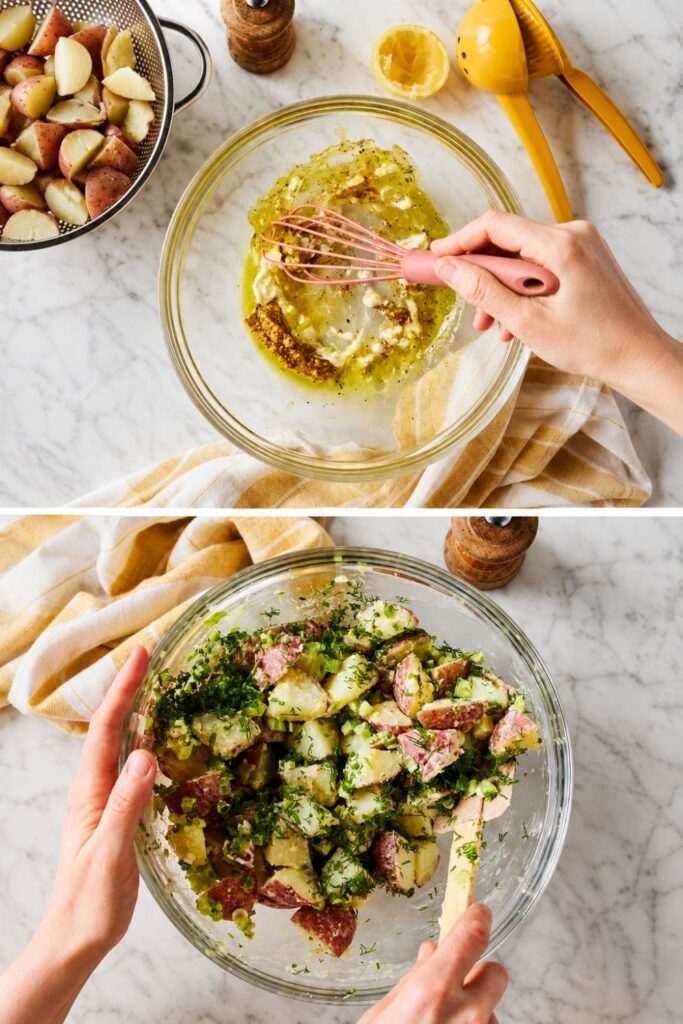
The dressing is made in a medium bowl by whisking together the olive oil, mustard, lemon juice, mayo, vinegar, garlic, salt, and several grinds of pepper. Everything goes in and gets whisked.
Emulsification is the goal. Oil and acid naturally separate, and a broken dressing gives you oily bites and sour bites instead of a consistent coating. Here you have two emulsifiers working together. The mustard contains compounds that surround oil droplets and keep them suspended, and the mayonnaise arrives as a pre-made emulsion that lends its stability to the mixture.
Whisk until the mixture looks uniformly cloudy and slightly thickened rather than showing oil floating on top of a liquid layer. It should coat the back of a spoon lightly and pour smoothly rather than in two distinct streams.
Season with several grinds of pepper as the recipe specifies, and taste before it goes anywhere near the potatoes. Adjusting the dressing on its own is far easier than trying to correct a whole bowl later.
Dressing While The Potatoes Are Still Warm
The recipe drains the potatoes and lets them cool slightly, then pours the dressing over. That word “slightly” is carrying real weight.
Warm potato absorbs dressing. The starch has gelatinized during cooking and hasn’t yet firmed back up, leaving the flesh open and receptive. Vinaigrette poured over warm chunks soaks into the surface layers rather than pooling around them, which means the seasoning goes into the potato instead of sitting on it.
Wait too long and you lose that. Fully cooled potato has retrograded starch, meaning its structure has tightened again, and a thin dressing mostly slides off. You’d taste dressing and potato as two separate things rather than one seasoned dish.
But don’t go the other direction either. The instruction says cool slightly, not use them straight from the colander. Very hot potatoes are fragile and more likely to break under stirring, and heat would wilt the delicate chives and dill added moments later.
The Hour In The Fridge And The Final Seasoning
After the vegetables and herbs are stirred in, the salad gets covered and refrigerated for at least an hour so the flavors can meld.
That time is doing something specific. The garlic mellows and spreads through the dressing, the herbs release their oils into it, the potato continues absorbing acid and salt, and the celery and scallions give up a little moisture that thins the vinaigrette slightly. What starts as dressed potatoes with things stirred in becomes a single dish.
Then comes the step people skip. When ready to serve, season the salad to taste, adding more lemon juice if desired.
This isn’t a formality. Chilling mutes flavor perception, particularly acidity and salt, so a salad that tasted balanced when you mixed it will often taste flat coming out of the fridge. Taste it cold, then adjust. More lemon juice sharpens it back up, and more salt brings the whole thing into focus.
Garnish with more chives and serve.
Ingredients
The list splits into three parts: the potatoes, the vinaigrette, and the fresh additions. The grainy Dijon and the two acids are the ones setting the character here.
- 2 pounds red potatoes, cut into 1½-inch chunks no peeling needed, the skins stay on
- Sea salt for cooking the potatoes 2 tablespoons goes into the cooking water
- ⅓ cup extra-virgin olive oil
- 2 tablespoons grainy Dijon mustard
- 1 tablespoon fresh lemon juice, plus more to taste
- 1 tablespoon mayonnaise
- 1 tablespoon white wine vinegar
- 3 garlic cloves, grated grating helps them dissolve into the dressing
- 1 teaspoon sea salt
- Freshly ground black pepper
- 4 celery stalks, chopped
- 3 scallions, chopped
- ¼ cup chopped fresh chives, plus more for garnish
- ¼ cup chopped fresh dill
Instructions
Make the dressing while the potatoes cook, so it’s ready when they come out of the pot.
- Cook the potatoes. Put the potatoes in a large pot and cover them with cold water by 1 inch, then stir 2 tablespoons salt into the cooking water. Bring it to a boil over high heat, then reduce the heat and simmer for 5 to 10 minutes, until the chunks are fork-tender with just a little resistance at the center. Drain and let them cool slightly.
- Whisk the dressing. In a medium bowl, whisk together the olive oil, mustard, lemon juice, mayo, vinegar, garlic, salt, and several grinds of pepper. Keep whisking until the mixture looks uniformly cloudy rather than separated.
- Dress and chill. Transfer the potatoes to a large bowl and pour in the dressing, stirring to coat. Add the celery, scallions, chives, and dill and stir to combine. Cover and refrigerate for at least 1 hour so the flavors can meld.
- Season and serve. When you’re ready to serve, season the salad to taste, adding more lemon juice if you’d like. Garnish with more chives and serve.
Red Potato Salad
Ingredients
Method
- Cook the potatoes. Put the potatoes in a large pot and cover them with cold water by 1 inch, then stir 2 tablespoons salt into the cooking water. Bring it to a boil over high heat, then reduce the heat and simmer for 5 to 10 minutes, until the chunks are fork-tender with just a little resistance at the center. Drain and let them cool slightly.
- Whisk the dressing. In a medium bowl, whisk together the olive oil, mustard, lemon juice, mayo, vinegar, garlic, salt, and several grinds of pepper. Keep whisking until the mixture looks uniformly cloudy rather than separated.
- Dress and chill. Transfer the potatoes to a large bowl and pour in the dressing, stirring to coat. Add the celery, scallions, chives, and dill and stir to combine. Cover and refrigerate for at least 1 hour so the flavors can meld.
- Season and serve. When you’re ready to serve, season the salad to taste, adding more lemon juice if you’d like. Garnish with more chives and serve.
Notes
Recipe Notes
A few practical points on prep and timing.
Cut the potato chunks as evenly as you can at 1½ inches. Within a 5 to 10 minute cooking window, small variations in size make a real difference between pieces that are still firm and pieces that have gone soft.
Chop the celery finely enough that it distributes through the bowl. Large chunks give you an occasional loud celery bite rather than consistent crunch throughout.
Reserve some chives when you chop, since the recipe calls for extra as a garnish at the end. Fresh, uncooked herbs scattered on top after chilling taste noticeably brighter than the ones that have been sitting in dressing for an hour.
This is designed to sit for at least an hour, which makes it a reasonable make-ahead dish, though the final seasoning step should always happen right before serving.
Common Questions
Can I use a different potato variety?
The recipe specifies red potatoes, and the choice matters here more than in a creamy salad. Waxy red potatoes hold their chunks through boiling and stirring, which is essential when the dressing is a thin vinaigrette with no thickening power. Starchy varieties like russets would break down and turn the dressing cloudy and starchy. Yukon golds sit in between and would work reasonably, though with slightly softer edges.
Do I have to peel the potatoes?
No, and the recipe doesn’t ask you to. Red potato skins are thin and tender enough to eat without any unpleasant texture, and leaving them on adds color and helps hold each chunk together during cooking. It also saves you the most tedious part of making potato salad.
Why is there mayonnaise in a vinaigrette-style dressing?
The single tablespoon isn’t there to make the salad creamy. Mayonnaise is already a stable emulsion of oil and egg, so adding a spoonful helps hold the olive oil and the two acids together and gives the dressing enough body to cling to the potatoes. Alongside the grainy Dijon, it’s what keeps the vinaigrette from splitting into oily and sour layers in the bowl.
A Potato Salad That Tastes Like Something
What separates this from the version most people grew up with isn’t one dramatic change, but a series of small decisions pulling in the same direction. Red potatoes instead of starchy ones, so the chunks stay whole. A grainy Dijon vinaigrette instead of a mayonnaise binder, with a single tablespoon of mayo doing structural work rather than flavor work. Two different acids instead of one, and half a cup of fresh herbs alongside four stalks of celery. The result is a salad you can eat a proper portion of without feeling weighed down, because the lemon, vinegar, and dill keep cutting back through the olive oil rather than letting it accumulate.
Two things are worth protecting when you make it. The first is the cooking window, since 5 to 10 minutes is short and overcooked red potatoes fall apart under a dressing with no thickening power to hold them together. The second is the final seasoning after the hour in the fridge, because cold mutes acidity and salt, and a bowl that tasted right when you mixed it will usually want more lemon before it reaches the table. Get those two right and the rest is forgiving. No peeling, one pot, one bowl for the dressing, and chilling time you can stretch if the schedule demands it.